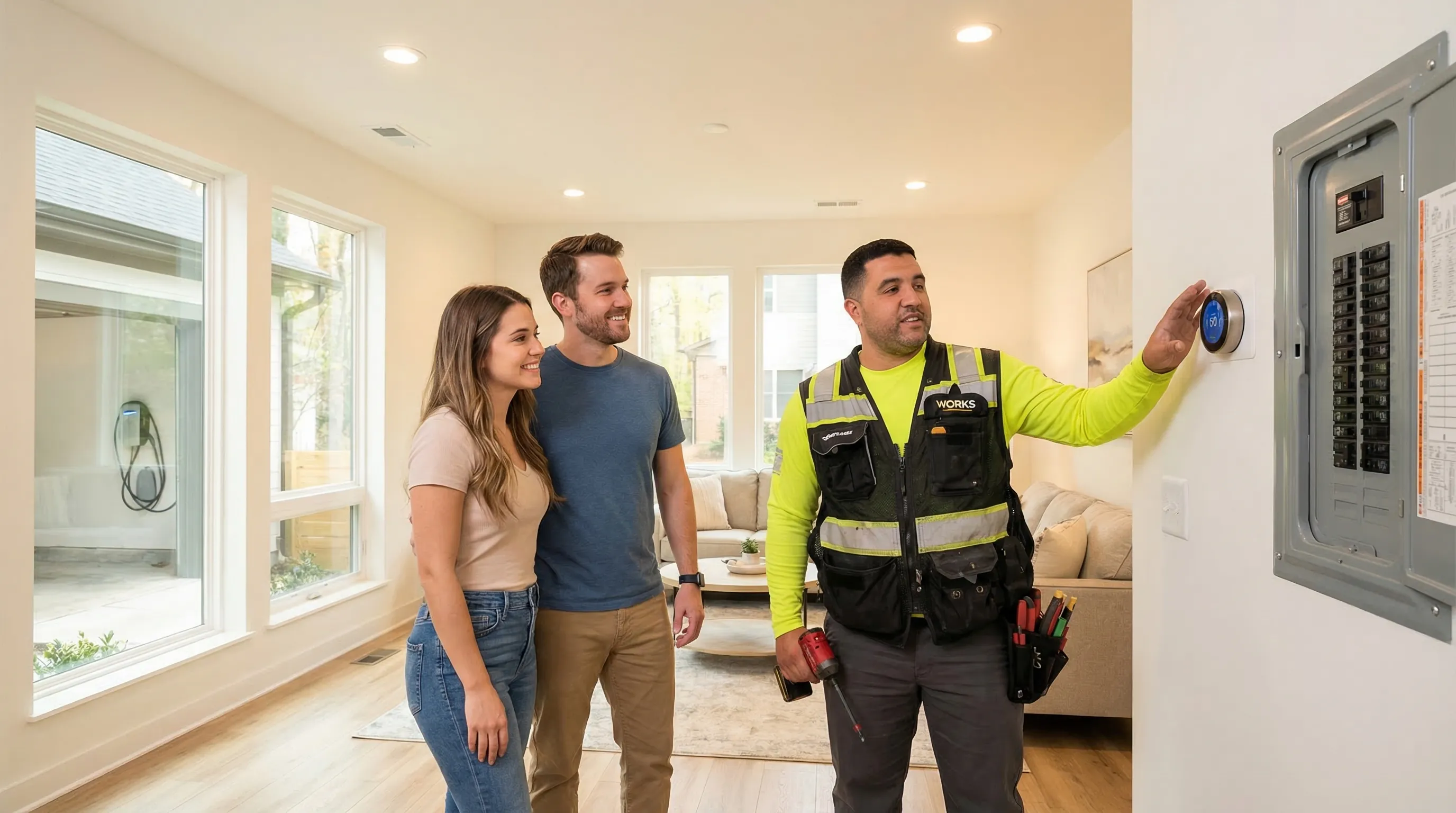
The average Georgia Power residential customer pays about $140 per month for electricity. In the summer, with air conditioning running 14 hours a day, that number climbs past $200 for many Atlanta households. A big chunk of that bill is not your HVAC system — it is inefficient lighting, outdated wiring, phantom loads from electronics, and appliances pulling more power than they should because your electrical infrastructure was designed for a different era.
Energy-efficient electrical upgrades are not about sacrificing comfort. They are about making your home's electrical system work smarter so you get the same (or better) results with less wasted energy. This guide covers every electrical upgrade worth considering, from quick wins that cost under $100 to major investments that pay for themselves over three to five years. Each section includes realistic cost ranges and expected savings based on what I see in Atlanta-area homes.
Why Electrical Efficiency Matters More in Atlanta
Atlanta sits in a hot-humid climate zone with 2,800+ cooling degree days per year. That means your air conditioning runs hard from April through October — roughly seven months. Every watt your home wastes on inefficient lighting, outdated appliances, and phantom loads adds to the thermal burden your HVAC system has to overcome. Incandescent bulbs, for example, convert 90% of their energy into heat. In a house with 40 incandescent bulbs, your light fixtures are working against your air conditioner, making it run longer and harder.
Georgia Power's residential rates have increased roughly 3-4% per year over the past decade. That trend is unlikely to reverse. Upgrades that reduce your kWh consumption today compound in value as rates continue rising. A $500 upgrade that saves $150/year at today's rates will save $165/year at 2028 rates and $180/year at 2030 rates.
LED Lighting Conversions: The Fastest Payback
If you have not already converted to LED throughout your home, this is the single best place to start. The math is straightforward.
A 60-watt incandescent bulb costs about $8.76 per year to run at 4 hours per day at Georgia Power's current rates. The LED equivalent — a 9-watt bulb that puts out the same 800 lumens — costs $1.31 per year. That is an 85% reduction per bulb. Multiply that across 30-40 light fixtures in a typical Atlanta home and you are looking at $200-$300 in annual savings from bulb swaps alone.
Beyond Bulb Swaps: Recessed LED Conversions
Older recessed can lights (the 6-inch cans common in Atlanta homes built in the 1990s and 2000s) use either incandescent floods or CFL bulbs inside an inefficient housing. Replacing the entire housing with integrated LED retrofit kits improves both efficiency and light quality. The retrofit kits are rated for 50,000 hours — that is over 30 years at 4 hours per day. They also produce less heat in the ceiling cavity, which reduces the thermal load on your HVAC system. Read our recessed lighting layout guide for room-by-room planning tips.
Commercial LED Upgrades
For businesses, the savings scale dramatically. A 5,000-square-foot commercial space lit with fluorescent T8 tubes typically uses 8,000-12,000 kWh per year on lighting alone. Converting to LED tubes or LED troffers cuts that to 3,000-5,000 kWh. At commercial electricity rates, that saves $500-$900 annually. Georgia Power also offers commercial rebates on qualifying LED retrofit projects. Our commercial LED lighting guide covers the details.
Cost: $200-$800 for whole-home LED conversion. $2,000-$8,000 for commercial spaces.
Annual savings: $200-$400 residential. $500-$900+ commercial.
Payback period: 6-18 months.
Smart Switches and Dimmers: Automated Efficiency
LED bulbs save energy by using less power to produce the same light. Smart switches and dimmers save energy by making sure lights are only on when and where they are needed.
Dimmer Switches
A dimmer switch reduces the voltage delivered to the bulb, which directly reduces energy consumption. Running LED bulbs at 75% brightness cuts their energy use by approximately 20%. In rooms where full brightness is rarely needed — dining rooms, bedrooms, living rooms — dimmers provide both ambiance and savings. Modern LED-compatible dimmers cost $25-$50 per switch installed.
Smart Switches with Scheduling
Smart switches (Lutron Caseta, Leviton Decora, TP-Link Kasa) connect to your home's Wi-Fi and allow scheduling, remote control, and integration with voice assistants. The energy savings come from automated scheduling — lights that turn off at midnight whether you remember or not — and occupancy detection that shuts off lights in empty rooms. A typical household wastes 20-30% of its lighting energy on lights left on in unoccupied rooms. Smart switches eliminate that waste.
Occupancy and Vacancy Sensors
For spaces like closets, laundry rooms, garages, and bathrooms, occupancy sensors are more practical than smart switches. The light turns on when someone enters and off after a set delay when the room is empty. These do not require Wi-Fi, have no app to configure, and cost $20-$40 per switch installed.
Cost: $25-$65 per switch/dimmer installed.
Annual savings: $150-$400 for a whole home.
Payback period: 1-3 years.
Free Download: Seasonal Electrical Maintenance Checklist
Keep your home's electrical system safe year-round with our printable seasonal checklist — built by a master electrician.
Get the Free ChecklistWhole-Home Surge Protection: Protecting Your Investment
This one is not about reducing your electricity bill directly — it is about protecting every energy-efficient upgrade you make. A single power surge can destroy LED drivers, smart switches, smart thermostats, and sensitive electronics. One well-placed lightning strike during an Atlanta thunderstorm can cost you $5,000-$15,000 in damaged equipment.
A whole-home surge protector installs at your main electrical panel and diverts voltage spikes to ground before they reach your branch circuits. It protects every outlet, switch, and hardwired device in your home. The cost is $300-$600 installed — a fraction of what a single surge event can cost you.
Cost: $300-$600 installed.
Potential savings: $5,000-$15,000 in avoided equipment damage per surge event.
Panel Upgrades: The Foundation for Everything Else
Many of the upgrades in this article — solar panels, EV chargers, whole-home surge protection — require available circuit space and sufficient amperage in your electrical panel. If your home still runs on a 100-amp panel (standard in Atlanta homes built before 1990), you are likely at or near capacity already. Adding a 40-amp EV charger circuit or a 60-amp solar inverter feed to a 100-amp panel is not physically possible without overloading the system.
A panel upgrade to 200 amps provides the capacity you need for current and future upgrades. It also replaces aging breakers that may not trip properly, reduces the risk of overloaded circuits, and brings your panel up to current NEC code standards. If your panel uses Federal Pacific Stab-Lok or Zinsco breakers, the upgrade is a safety necessity regardless of efficiency goals.
Important
If your panel uses Federal Pacific Stab-Lok or Zinsco breakers, replacement is a safety necessity — not just an efficiency upgrade. These brands have documented failure rates where breakers do not trip during a fault, creating a direct fire risk.
Cost: $1,800-$3,500 for a 200-amp upgrade.
Value: Enables all downstream efficiency upgrades. Adds to home resale value. Improves safety.
Solar Panel Electrical Preparation
Georgia ranks 12th nationally in installed solar capacity, and metro Atlanta's solar market has grown 40% year-over-year since 2022. Going solar is one of the most impactful energy-efficiency moves a homeowner can make — but the electrical work needs to be done right.
Before solar panels go on the roof, your electrical system needs to be ready. That means:
- 200-amp panel minimum. Most residential solar installations require a dedicated 40-60 amp breaker for the inverter backfeed. A 100-amp panel cannot accommodate this.
- Conduit and wire run from the roof to the panel. The solar installer handles the panels and inverter, but an electrician often handles the service entrance work, panel modifications, and final interconnection.
- Net metering compliance. Georgia Power's net metering program requires specific metering equipment and interconnection agreements. Your electrician needs to coordinate with the utility.
- Rapid shutdown compliance. NEC 2020 requires module-level rapid shutdown on all new rooftop solar installations. This is a fire safety requirement that affects equipment selection and wiring.
Read our complete guide to solar panel electrical requirements for a detailed breakdown of what your home needs before installation day.
Cost: Electrical prep: $500-$2,000. Full solar system: $15,000-$25,000 (before federal tax credit).
Annual savings: $1,200-$2,400 on electricity.
Payback period: 7-12 years (with 30% federal tax credit).
EV Charger Installation: Preparing for Electric Vehicles
Electric vehicle adoption in metro Atlanta is accelerating. Georgia registered over 85,000 EVs and plug-in hybrids by the end of 2025, with metro Atlanta accounting for more than 70% of that total. If you own or plan to buy an EV, home charging is the most convenient and cost-effective way to keep it charged.
A Level 2 home charger (240-volt, 40-50 amp) adds 25-30 miles of range per hour of charging. That means a full overnight charge every night. The electrical requirements include a dedicated 50-amp circuit from your panel to the charging location — typically the garage. If your garage is far from the panel, the wire run can be significant.
Even if you do not own an EV yet, making your home EV-ready by running the circuit and installing the outlet now costs significantly less than doing it later (when drywall may need to be opened and finished spaces may need to be disturbed). It also adds value to your home — EV-ready homes sell faster in Atlanta's current market.
Our detailed EV charger installation guide covers charger types, costs, and the permitting process in metro Atlanta.
Cost: $800-$2,500 for circuit and charger installation.
Annual savings vs. gas: $800-$1,500 (depending on driving habits and gas prices).
Home value impact: EV-ready homes sell for 2-5% premium in metro Atlanta.
Dedicated Circuits for High-Draw Appliances
Older Atlanta homes were wired with fewer circuits than modern appliances demand. When multiple high-draw devices share a circuit — a microwave and a toaster on the same kitchen circuit, for example — the wiring runs hotter, the breaker trips more often, and the system wastes energy through resistive losses in overloaded conductors.
Adding dedicated circuits for high-draw appliances (refrigerator, microwave, dishwasher, washing machine, bathroom heaters) reduces circuit loading, prevents nuisance trips, and marginally improves efficiency. The bigger benefit is protecting your appliances — devices running on overloaded circuits have shorter lifespans because they do not receive stable, clean power.
Cost: $200-$400 per dedicated circuit.
Value: Extends appliance life, eliminates nuisance trips, reduces fire risk.
Whole-Home Energy Monitoring
You cannot optimize what you cannot measure. Whole-home energy monitors (Sense, Emporia Vue, Span) install at your electrical panel and track energy consumption by circuit in real time. They show you exactly which circuits — and in some cases, which appliances — are consuming the most power and when.
The data from these monitors often reveals surprising waste. I installed a Sense monitor in an East Atlanta home last year and it identified a chest freezer in the garage that was running 22 hours a day because the door gasket had failed. The freezer was consuming $35/month in electricity. A $12 replacement gasket fixed it. Without the monitor, that waste would have continued indefinitely.
Cost: $150-$400 for the monitor. $100-$200 for installation.
Typical savings identified: 5-15% of total electricity bill.
Payback period: 6-18 months.
Electrical Vehicle-Ready Infrastructure
Even if an EV is not in your immediate plans, installing the conduit and a 240V outlet in your garage during another electrical project adds minimal cost and significant future value. Running a conduit from the panel to the garage during a panel upgrade, for example, might add $200-$400 to the project. Doing it as a standalone project later costs $800-$1,200 because the electrician has to make a separate trip and potentially open finished walls.
This "future-proofing" approach applies to solar as well. If you are upgrading your panel, ask your electrician to install a 60-amp breaker space and a conduit stub for a future solar interconnection. The marginal cost during a panel upgrade is minimal compared to the cost of adding it retroactively. More detail in our EV-ready home electrical guide.
Prioritizing Your Upgrades: Where to Start
Not every home needs every upgrade. Here is how I recommend Atlanta homeowners prioritize based on the biggest impact per dollar spent.
Tier 1: Quick Wins (Under $500)
- LED bulb conversion throughout the house
- Dimmer switches in living areas
- Occupancy sensors in utility rooms
- Smart power strips for home office and entertainment centers
Tier 2: Mid-Range Upgrades ($500-$2,000)
- Whole-home surge protection
- Smart switch installation in main living areas
- Dedicated circuits for overloaded kitchen and laundry
- Whole-home energy monitor
Tier 3: Major Investments ($2,000-$25,000)
- 200-amp panel upgrade (if currently 100-amp)
- EV charger installation
- Solar panel electrical preparation and installation
- Whole-home rewiring (if wiring is 40+ years old)
Start with Tier 1. The payback is fast, the disruption is minimal, and the savings fund the next round of upgrades. Move to Tier 2 once the quick wins are in place. Plan Tier 3 projects around major life events — buying an EV, adding solar, selling the home — or combine them with an already-planned renovation to reduce cost.
Georgia Rebates and Incentives
Several programs help offset the cost of energy-efficient electrical upgrades in Georgia:
- Federal Solar Tax Credit (ITC): 30% of the total installed cost of a solar system, including electrical work. No cap. Available through 2032.
- Georgia Power Commercial Rebates: Up to $0.10 per kWh saved annually for qualifying commercial LED retrofit projects.
- Federal EV Charger Tax Credit: 30% of the cost of purchasing and installing a home EV charger, up to $1,000 for residential installations. Available through 2032 in qualifying areas (most of metro Atlanta qualifies).
- Georgia Property Tax Exemption: Solar panels are exempt from property tax assessment in Georgia — your property taxes will not increase when you add solar.
- Net Metering: Georgia Power credits you at the retail rate for excess solar energy you send back to the grid, up to your total consumption.
Pro Tip
The homeowners who save the most money are the ones who think of their electrical system as a whole — not isolated projects. A panel upgrade that enables solar, EV charging, and surge protection simultaneously is worth three times what it costs in avoided rework, bundled labor savings, and compounding energy savings over a decade.
Getting Started with an Energy Efficiency Assessment
Every home is different. A 1960s ranch in Sandy Springs has different priorities than a 2010 townhouse in Brookhaven. The right starting point depends on your panel capacity, wiring condition, current energy usage, and what upgrades you are considering in the next three to five years.
I offer energy efficiency assessments for Atlanta homeowners that include a panel evaluation, circuit load analysis, and a prioritized upgrade plan with cost estimates. We look at your Georgia Power bill, walk your home circuit by circuit, and identify where you are wasting the most energy and money. From there, we build a phased plan that fits your budget and timeline.
View our full list of electrical services or request a free estimate to get started.
Frequently Asked Questions
LED lighting upgrades offer the fastest return on investment. Replacing all incandescent and CFL bulbs with LEDs typically reduces lighting energy use by 75% and pays for itself within 6-12 months. Adding dimmer switches and occupancy sensors further increases savings. For a whole-home LED conversion, expect to spend $200-$800 depending on the number of fixtures.
It depends on your current panel capacity. Solar installations and Level 2 EV chargers each require 40-60 amps of dedicated circuit capacity. If your panel is 100 amps or less, or if your existing circuits are already heavily loaded, a panel upgrade to 200 amps is usually necessary before adding solar or EV charging. A licensed electrician can perform a load calculation to determine your needs.
Smart switches with scheduling and occupancy sensing typically reduce lighting energy use by 10-30% compared to manual switches. Dimmers save proportional to how much you dim — running lights at 75% brightness cuts that circuit's energy use by roughly 20%. Combined with LED bulbs, smart switches and dimmers in a typical Atlanta home can save $150-$400 per year on lighting costs alone.
Ready to Lower Your Energy Bills?
Get a personalized energy efficiency assessment from a master electrician. We will identify the upgrades that save you the most money and build a plan that fits your budget.
Schedule Your Assessment