Atlanta averages 50 thunderstorm days per year — the highest of any major metro area east of the Mississippi. Each of those storms delivers lightning, and each lightning strike within a mile of a power line can send a voltage spike surging through the grid and into your home. But lightning is not the only threat. Utility switching, transformer faults, and even your own HVAC compressor cycling on and off generate smaller surges that chip away at your electronics day after day.
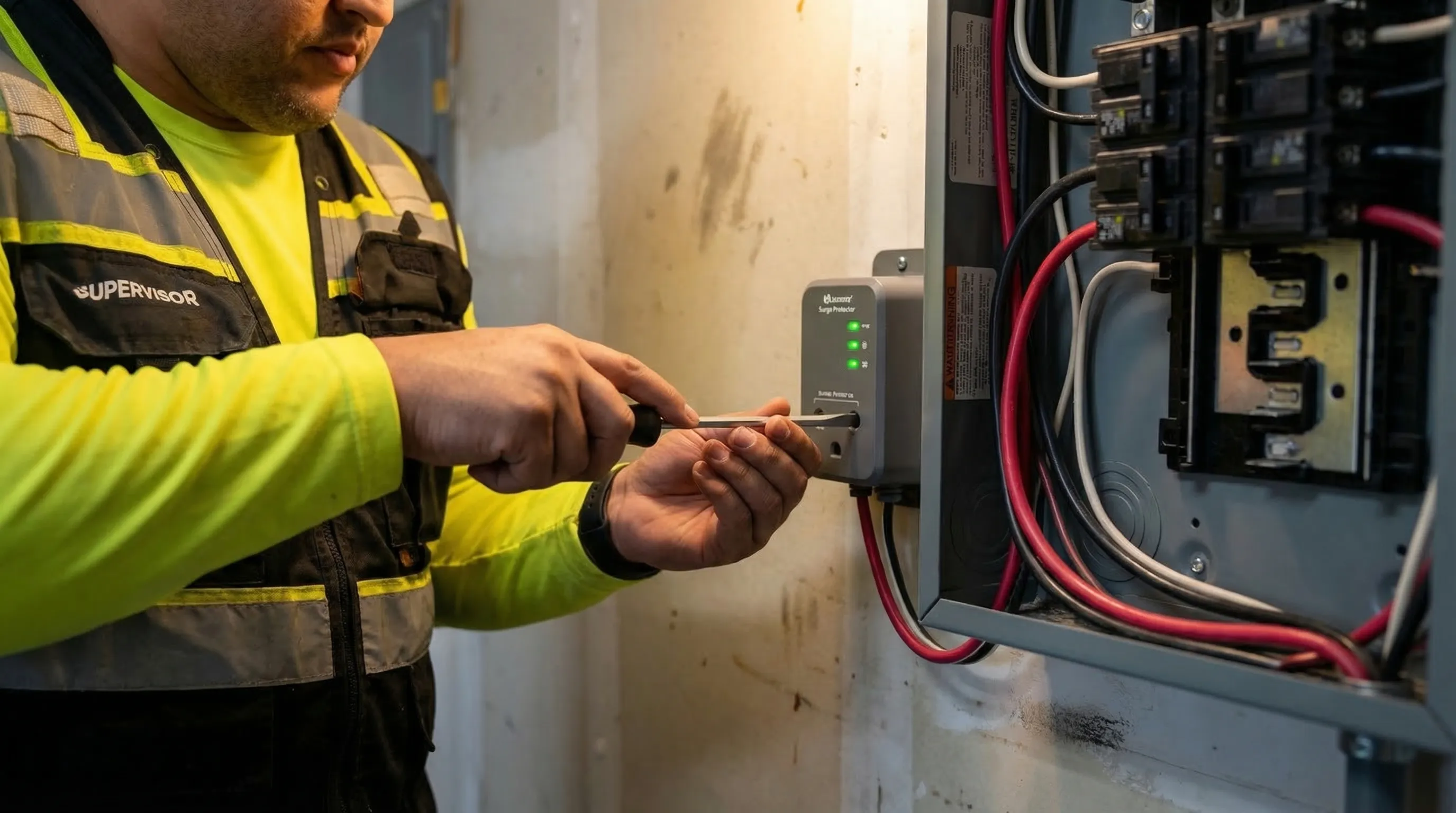
A whole-home surge protector is one of the least expensive and most effective pieces of electrical equipment you can install. It sits at your main panel, absorbs voltage spikes before they reach your branch circuits, and protects every outlet, appliance, and hardwired device in your home. Here is everything you need to know about how it works, what it costs, and why it matters.
What Is a Power Surge and Why Should You Care?
A power surge is a brief spike in voltage above the standard 120/240 volts your home is designed to receive. Surges range from small (a few volts above normal, lasting microseconds) to massive (thousands of volts from a lightning strike). Your electronics are designed to operate within a narrow voltage window. When voltage spikes outside that window, circuits overheat, capacitors blow, and microprocessors fry.
Where Surges Come From
- Lightning: A direct strike on a power line can push 100,000+ volts into the system. A nearby strike (within a mile) induces surges of 1,000-10,000 volts. Atlanta's storm frequency makes this a near-constant seasonal risk from March through October.
- Utility switching: When Georgia Power switches transformer loads or restores power after an outage, the reconnection often sends a surge down the line. This is why appliances sometimes fail right after the power comes back on during a storm.
- Internal sources: Your own HVAC compressor, refrigerator, and washing machine generate small surges every time they cycle on. These 5-20 volt spikes happen dozens of times per day. Individually, they are harmless. Cumulatively over months and years, they degrade the circuits in smart TVs, computers, and LED drivers.
- Neighbor's load: If your home shares a transformer with several neighbors, heavy load cycling on their side of the transformer can send voltage fluctuations into your home.
How Whole-Home Surge Protectors Work
A whole-home surge protector (also called a Type 2 SPD — Surge Protective Device) installs at your main electrical panel, either directly wired to a dedicated breaker or integrated into the panel itself. Inside the unit are metal oxide varistors (MOVs) — semiconductor components that act as pressure relief valves for voltage.
Under normal conditions (120/240V), the MOVs have high resistance and do nothing. When voltage spikes above a set threshold — typically 330-400 volts — the MOVs instantly drop to near-zero resistance and divert the excess voltage to ground. The surge energy is absorbed by the MOVs and converted to heat. The process happens in nanoseconds, fast enough to clamp the surge before it reaches your branch circuits.
Key Specifications to Look For
- Surge current rating (kA): This is the maximum surge current the unit can handle in a single event. Look for 50 kA minimum. Premium units are rated for 100-200 kA.
- Joule rating: This measures the total energy the MOVs can absorb over their lifetime. Higher is better. Aim for 50,000 joules minimum. Premium units run 72,000-100,000 joules.
- Clamping voltage: This is the voltage level at which the device activates. Lower is better. UL standard is 330V for Type 2 devices. A unit with 330V clamping lets less surge energy through than one rated at 400V.
- Protection modes: A good unit protects all three modes: line-to-neutral (L-N), line-to-ground (L-G), and neutral-to-ground (N-G). All three modes matter because surges can travel on any conductor.
- Indicator light: Essential. This LED tells you whether the MOVs are still functional. When the light goes off, the protection is compromised and the unit needs replacement.
Whole-Home Surge Protection vs. Power Strip Surge Protectors
The $20 surge protector power strip from the hardware store has its place, but it is not a substitute for whole-home protection. Here is why:
- Coverage: A power strip protects only what is plugged into it. Your HVAC system, water heater, hardwired smoke detectors, garage door opener, oven, dishwasher, and washer/dryer are all unprotected by power strips because they are hardwired or plugged into dedicated outlets.
- Capacity: Most power strip surge protectors are rated for 1,000-4,000 joules. A whole-home unit handles 50,000-100,000 joules. Against a significant lightning-induced surge, the power strip is overwhelmed instantly.
- Response time: Whole-home SPDs respond in less than 1 nanosecond. Power strips typically respond in 1-5 nanoseconds. That difference matters at surge voltages in the thousands.
The best approach is layered protection. The whole-home unit at the panel handles the big surges. Point-of-use strip protectors at your computer, TV, and other sensitive electronics handle whatever residual surge makes it past the panel. Together, they reduce the surge reaching your equipment to near zero.
Pro Tip
Check the indicator light on your whole-home surge protector every few months. When the light goes off, the MOVs inside are depleted and the unit is no longer protecting your home. Each major surge event consumes some of the MOV capacity. After a direct lightning strike, the unit often needs immediate replacement.
Free Download: Seasonal Electrical Maintenance Checklist
Keep your home's electrical system safe year-round with our printable seasonal checklist — built by a master electrician.
Get the Free ChecklistWhat Does Installation Look Like?
Installation takes about one to two hours. The electrician mounts the SPD near the main panel (some units install directly inside the panel) and connects it to a dedicated 2-pole breaker. The ground connection runs to the panel's grounding bus. The key installation details that matter:
- Wire length: The leads from the SPD to the panel should be as short as possible — under 6 inches is ideal. Longer leads add inductance, which slows the response time and reduces effectiveness.
- Dedicated breaker: The SPD gets its own 2-pole breaker (typically 15-20 amp). It does not share a breaker with anything else.
- Grounding: Effective surge protection depends on a solid ground connection. If your home's grounding system is undersized or corroded, that needs to be addressed as part of the installation. Homes with older 100-amp panels sometimes need a grounding upgrade. If you are already considering a panel upgrade, adding surge protection during that project is the most cost-effective approach.
What Whole-Home Surge Protection Costs in Atlanta
Here is what Atlanta homeowners can expect to pay:
- Basic unit (50 kA, 50,000 joules): $300-$450 installed
- Premium unit (100+ kA, 72,000+ joules, connected equipment warranty): $450-$800 installed
- Add-on during panel upgrade: $200-$350 (labor savings from combining projects)
To put that in perspective: replacing a fried HVAC control board costs $500-$1,500. A new refrigerator compressor runs $800-$2,000. A home theater system can cost $2,000-$10,000. The surge protector pays for itself the first time it stops a significant surge — and in Atlanta, that is not a question of "if" but "when."
Common Questions About Surge Protection in Atlanta
Does Georgia Power provide any surge protection?
Georgia Power offers a "Surge Protection Program" for about $8/month that covers your electric meter and some connected equipment. It is a reasonable add-on, but it is not the same as a properly installed whole-home SPD at your panel. The utility program primarily covers surges from the grid side — it does not protect against internally generated surges from your own appliances, and the coverage limits are capped.
Will surge protection help during a storm?
Yes, significantly. A whole-home SPD protects against the voltage surges that accompany lightning strikes and power restoration after outages. It does not protect against a direct lightning strike on your service entrance (nothing fully stops 100 million volts), but it handles the far more common nearby-strike surges that damage electronics in homes without protection.
Do I need GFCI or AFCI protection too?
Surge protection, GFCI protection, and AFCI protection address different hazards. Surge protectors handle voltage spikes. GFCI outlets prevent electrocution from ground faults (required in kitchens, bathrooms, and outdoor areas). AFCI breakers detect dangerous arcing that can start fires. A well-protected home has all three. They complement each other — none replaces the others.
Safety Warning
I install surge protectors on every panel upgrade I do in Atlanta. The cost is minimal compared to the panel work itself, and I have never had a customer regret it. But I have had plenty of customers call me after a storm wishing they had installed one before the surge fried their HVAC, their smart home system, and their $3,000 refrigerator.
Frequently Asked Questions
A whole-home surge protector typically costs $300-$600 installed, including the device and labor. Premium units with higher joule ratings and warranty coverage run $400-$800. Compared to the cost of replacing a fried HVAC control board ($500-$1,500), refrigerator compressor ($800-$2,000), or home theater system ($2,000-$10,000), it is one of the most cost-effective electrical upgrades available.
Ideally, yes. A layered approach provides the best protection. The whole-home surge protector at the panel handles large surges from the utility line. Point-of-use surge protectors at individual outlets provide a second layer of defense for sensitive electronics like computers, TVs, and gaming consoles. Together, they reduce the surge reaching your equipment to near zero.
Most whole-home surge protectors are rated for 50,000-100,000 joules of cumulative surge absorption. In the Atlanta area, with frequent thunderstorms and utility switching events, a quality unit typically lasts 5-10 years before the MOVs degrade enough to need replacement. Units with indicator lights tell you when protection has been compromised. Read more about protecting your home in our energy-efficient upgrades guide.
Protect Your Home Before the Next Storm
Whole-home surge protection installs in under two hours and protects everything in your home. Get a free quote from a master electrician.
Get a Surge Protection Quote