Atlanta Electrical Services
You can buy the fanciest smart switch on the market, but if there's no neutral wire in the box, it's not going on the wall. That's the gap most homeowners hit — the technology is ready, but the wiring behind the wall isn't. Smart home upgrades aren't just about devices. They're about the electrical infrastructure that makes those devices work right.
I'm Jordan Jones, master electrician and owner of JD Works Electrical. I've been wiring homes across Metro Atlanta for over 15 years, and smart home work has become a growing part of what we do. From retrofitting neutral wires into 1970s switch boxes in Decatur to wiring whole-house Lutron Caseta systems in new builds out in Suwanee, we handle the electrical side so your smart devices actually function the way they're supposed to.
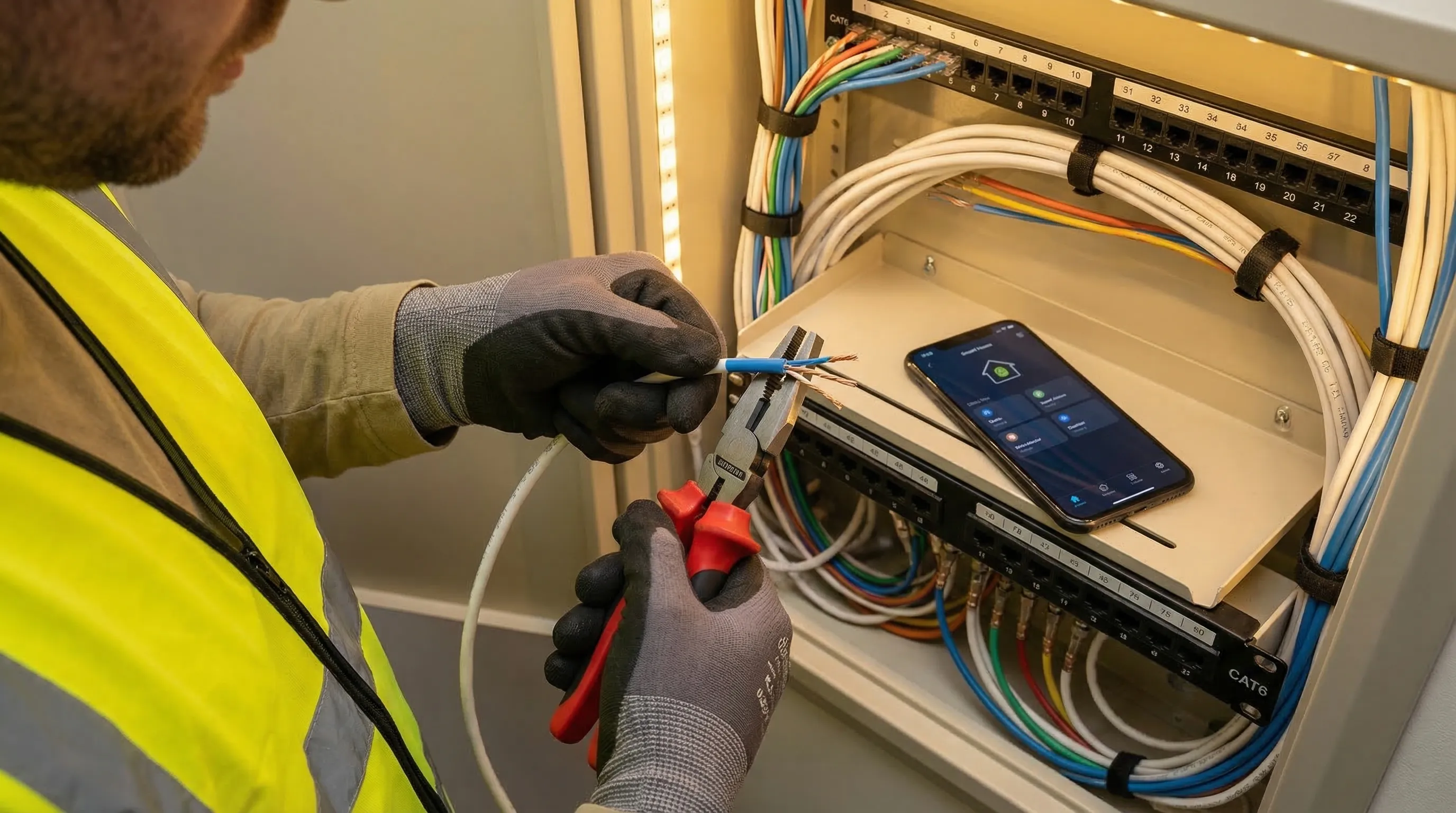
Here's what a lot of people don't realize: smart switches, dimmers, fan controllers, and thermostats all have specific wiring requirements. Some need a neutral wire. Some need a ground. Some need a C-wire at the thermostat that your old HVAC system never had. And if you're trying to run 30 Wi-Fi devices on a basic router, you're going to have connectivity issues that have nothing to do with your electrician. We look at the full picture — wiring, panel capacity, network load, and device compatibility — before we install anything. We're licensed and insured in Georgia, and we don't leave until everything's tested and working.
Why It Matters
Forgot to turn off the porch lights? Left the AC running? Smart switches and thermostats let you control everything from your phone — whether you're upstairs or across town. Set schedules, create scenes, and automate the stuff you'd otherwise forget.
Smart thermostats like Ecobee and Nest learn your schedule and stop heating or cooling an empty house. Smart dimmers reduce wattage when full brightness isn't needed. Occupancy sensors turn lights off in empty rooms. Small savings per device add up fast across a whole home.
Smart lighting that turns on and off at random intervals makes it look like someone's home when you're traveling. Pair that with smart locks, video doorbells, and motion-activated exterior lights, and you've got a security system that doesn't cost a monthly fee.
Atlanta buyers — especially in the 30-to-45 age range — expect smart features. A properly wired smart home with hardwired switches (not just Wi-Fi bulbs) is a selling point. It shows the home's been updated thoughtfully, not just patched with gadgets.
Set your living room to "movie night" with one tap — dimmers drop to 20%, the hallway goes off, and the TV backlighting kicks on. Morning routine? Lights ramp up gradually at 6:30 AM. Smart dimmers and scenes make it happen without walking to five different switches.
Our Process
Step 01
We open switch boxes to check for neutral wires, verify grounding, and assess your panel capacity. We also look at your Wi-Fi setup — if your router can't handle the device load, we'll flag that before you buy anything.
Step 02
We recommend the right ecosystem (Lutron, Z-Wave, Matter) based on your home, budget, and what you want to automate. You get a clear quote covering wiring modifications, devices, hubs, and installation labor.
Step 03
We run neutral wires where they're missing, install smart switches and dimmers, wire thermostats with C-wire connections, set up hubs, and configure device pairing. Everything is wired to code — no loose wires, no improvised connections.
Step 04
We test every device, verify app control, set up your scenes and schedules, and walk you through how everything works. You'll know how to use every switch, adjust every scene, and troubleshoot common issues before we leave.
Common Questions
Most smart switches do require a neutral wire to stay powered when the light is off. The neutral (white wire) provides the return path that keeps the smart switch's Wi-Fi or Zigbee radio running 24/7. Homes built after the mid-1980s usually have neutrals in every switch box. Older Atlanta homes often don't — the neutral was run to the fixture instead of the switch. We can check your switch boxes and, if neutrals are missing, we'll either run new wire or recommend no-neutral smart switches like the Lutron Caseta line that work without one.
It depends on what you're doing. Replacing a standard switch with a smart switch (where neutral wire already exists) runs $75 to $150 per switch installed. Running a new neutral wire to a switch box costs $150 to $350 per box depending on accessibility. A whole-home smart switch package for a typical 15-to-20-switch Atlanta home runs $2,000 to $5,000 installed. Smart thermostat installation is $150 to $300 including wiring. We price every job after seeing the existing wiring.
The big ecosystems are Apple HomeKit, Google Home, Amazon Alexa, and Samsung SmartThings. The new standard called Matter (built on Thread networking) is designed to make devices work across all platforms. For reliability, we recommend picking one primary ecosystem and sticking with it. Lutron Caseta works with all major platforms and uses its own radio frequency instead of Wi-Fi, which makes it the most reliable smart lighting system we install. We'll help you pick a setup that matches your household.
Wi-Fi smart devices connect directly to your router — no hub needed, but they add load to your network. If you have 30+ devices, your router can bog down. Z-Wave operates on a separate 908 MHz frequency and creates a mesh network where each device strengthens the signal. It requires a hub (like SmartThings or Hubitat) but doesn't touch your Wi-Fi. Zigbee runs on 2.4 GHz, also uses mesh networking, and also needs a hub. Zigbee devices tend to be cheaper. Z-Wave has less interference since it's on its own frequency. For most Atlanta homeowners, we recommend Lutron's Clear Connect (proprietary RF) for lighting and Z-Wave or Matter for everything else.
Absolutely. We've wired smart switches into 1940s Atlanta bungalows and 1960s ranch houses. The main challenge in older homes is missing neutral wires in switch boxes and outdated two-wire (non-grounded) circuits. We solve the neutral issue by pulling new wire or using no-neutral-required switches. For ungrounded circuits, we can add grounding or install GFCI protection upstream. Older homes may also need panel capacity upgrades if you're adding a lot of powered devices. None of these are deal-breakers — they just take a licensed electrician who knows what they're working with.
Related Services
Smart hubs, home servers, and network equipment work best on their own circuits. We install dedicated lines so your smart infrastructure stays powered and protected.
Learn MoreEgress lighting, dedicated circuits for fire alarm and sprinkler systems, emergency lighting, and inspection-ready installations for restaurants, retail, and warehouses.
Learn MoreBefore upgrading to smart, it's worth knowing the condition of your existing wiring. Our inspection identifies missing neutrals, grounding issues, and panel limitations.
Learn MoreWhat Our Customers Say
"We needed a Level 2 charger installed and two other companies quoted us way more and couldn't get to us for weeks. Jordan came out in two days, ran a dedicated circuit from the panel, and had us charging that evening."
Priya S.
Homeowner — Sandy Springs, GA