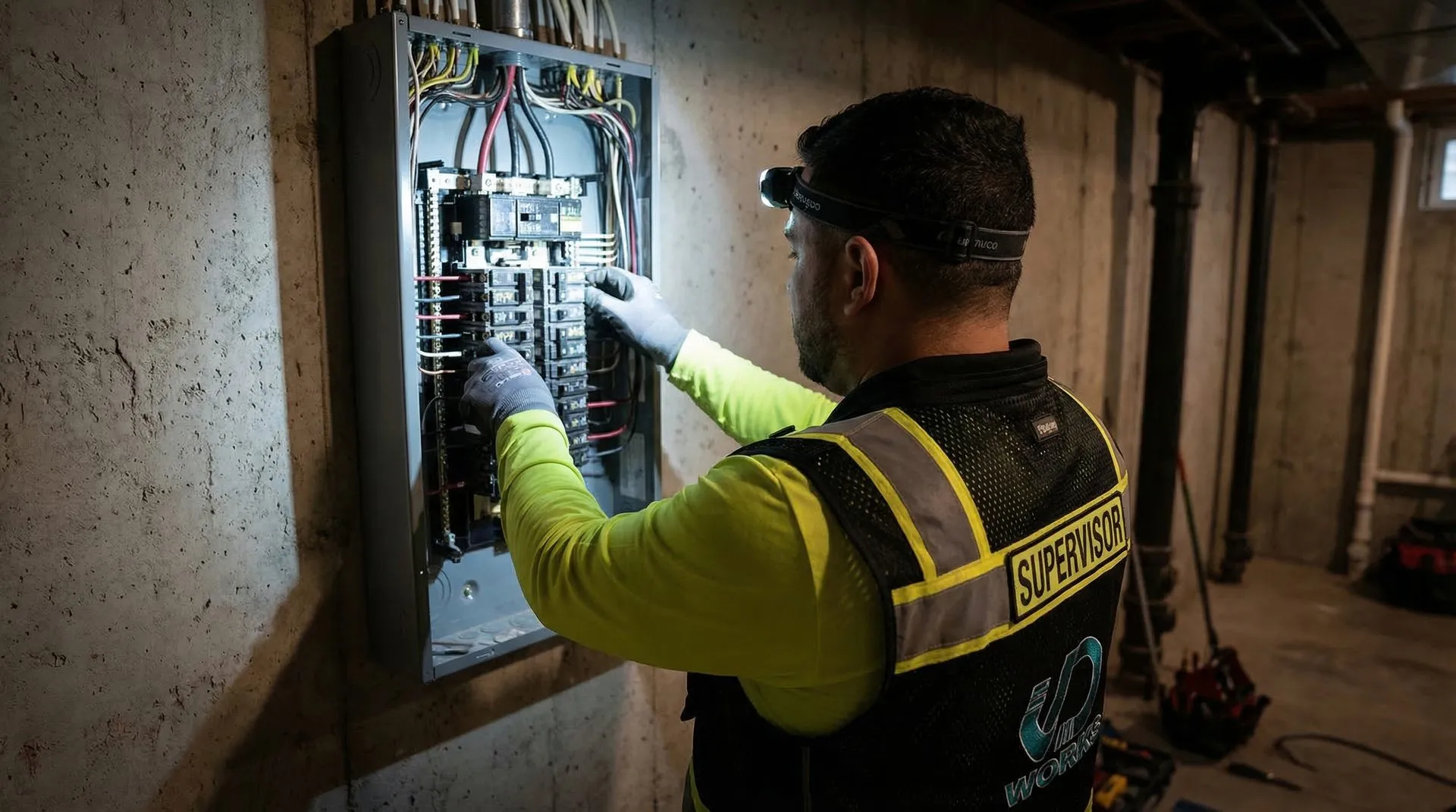
Your electrical panel is the central nervous system of your home. Every light switch, outlet, appliance, and HVAC unit draws power through that metal box mounted in your garage, basement, or utility closet. And if that panel was installed 25 or 30 years ago, there is a good chance it cannot keep up with the electrical demands of a modern Atlanta household.
I have replaced hundreds of panels across Fulton, DeKalb, Gwinnett, and Cobb counties. The most common scenario: a homeowner calls because breakers trip constantly, or they want to install an EV charger or hot tub and their electrician tells them the panel cannot handle the load. This guide covers everything you need to know about electrical panel upgrades — when you need one, what is involved, what it costs, and how to make sure the job is done right.
What Does an Electrical Panel Actually Do?
The electrical panel — also called a breaker box, load center, or distribution board — receives power from Georgia Power's utility lines through your meter and distributes it across individual circuits in your home. Each circuit breaker is designed to trip and cut power if the circuit draws more amperage than its wiring can safely carry. That tripping action prevents overheated wires, melted insulation, and house fires.
Older panels use fuses instead of breakers. The function is the same — protect the wiring — but fuses burn out and need physical replacement. Breakers flip a switch and can be reset. If your home still has a fuse box, an upgrade is not optional. It is overdue.
The panel also serves as the main disconnect for your entire home. In an emergency — a flood, a fire, or a downed power line in the yard — you need to kill all power from one location. A functioning, properly labeled panel gives you that control.
Signs Your Panel Needs an Upgrade
Not every electrical issue requires a full panel replacement. But several symptoms point directly to a panel that has reached the end of its useful life or cannot meet your home's current needs.
1. Breakers Trip Frequently
An occasional trip is normal — it means the breaker did its job. But if you are resetting the same breaker every week, or if multiple breakers trip at once, the panel is either undersized or the breakers themselves are failing. Worn breakers lose their calibration over time and stop tripping at the correct amperage, which creates a fire risk. Read more about why your circuit breaker keeps tripping for a deeper look at this issue.
2. You Still Have a Fuse Box
Fuse panels were standard in homes built before 1965. They typically provide 60 amps of total capacity — enough for a house with a few lights, a radio, and a refrigerator. The average Atlanta home today pulls 150 to 200 amps during peak usage. A fuse box cannot safely deliver that kind of power, and most home insurance companies charge higher premiums or refuse coverage altogether for homes with fuse panels.
3. You Are Adding Major Appliances or Systems
An EV charger installation typically requires a dedicated 50-amp circuit. A tankless water heater may need two or three 40-amp circuits. A hot tub, a workshop, a home addition — each of these demands dedicated circuits that an older 100-amp panel may not have room for. If the panel is full, adding a subpanel or upgrading the main panel are your two options.
4. Visible Damage or Corrosion
Open your panel and look inside. Rust, scorch marks, melted plastic on bus bars, and a burning smell all indicate serious problems. Corroded connections increase resistance, which generates heat, which accelerates corrosion — a feedback loop that ends with an electrical fire.
5. The Panel Is a Known Hazard Brand
Federal Pacific Electric (FPE) Stab-Lok panels and Zinsco panels are two brands with documented failure rates. FPE breakers have been shown in testing to fail to trip up to 25% of the time. Zinsco breakers can fuse to the bus bar and become impossible to turn off. If your home has either brand, replacement is strongly recommended regardless of whether you are experiencing symptoms. Check our full article on signs your Atlanta home needs rewiring for more red flags to watch for.
6. Flickering Lights and Warm Outlets
Lights that dim when you turn on a large appliance indicate voltage drop — the panel and wiring cannot maintain stable voltage under load. Outlets or switches that feel warm to the touch suggest loose connections or undersized wiring somewhere in the circuit. Both warrant professional evaluation.
100-Amp vs. 200-Amp Panels: Which Do You Need?
Most homes built before 1980 in Atlanta have 100-amp service. That was adequate when central air conditioning was a luxury and the average household had one television. It is not adequate for a 2026 household with an HVAC system, electric dryer, dishwasher, multiple computers, and plans for an EV charger.
When 100 Amps Is Enough
A small home under 1,500 square feet with gas heating, gas water heater, gas dryer, and no plans for major electrical additions can operate on 100-amp service. This describes a shrinking number of homes in metro Atlanta, but they exist — particularly older bungalows in neighborhoods like Grant Park, Kirkwood, and East Lake.
When You Need 200 Amps
If you have central air conditioning, an electric range or dryer, and plan to add anything that draws 30 amps or more — a Level 2 EV charger, a workshop, a pool pump, or commercial kitchen equipment — you need 200-amp service. This is the standard for new construction in Georgia and the recommendation for any panel upgrade in 2026.
When You Need 320 or 400 Amps
Large homes over 4,000 square feet, homes with heated pools, or homes with both an EV charger and a commercial kitchen equipment circuit may need 320-amp or 400-amp service. This requires two 200-amp panels or a 400-amp meter base with parallel feeds. It is less common in residential work but increasingly requested in areas like Buckhead, Sandy Springs, and Alpharetta where larger homes are the norm.
Free Download: Seasonal Electrical Maintenance Checklist
Keep your home's electrical system safe year-round with our printable seasonal checklist — built by a master electrician.
Get the Free ChecklistWhat Happens During a Panel Upgrade
A panel upgrade is a significant electrical project, but it is also one of the most straightforward for an experienced electrician. Here is what the process looks like from start to finish.
Step 1: Assessment and Load Calculation
Before any work begins, I perform a load calculation per NEC Article 220. This accounts for every circuit in the home, every planned addition, and the total demand under worst-case conditions. The calculation determines whether 200-amp service is sufficient or whether a larger service is warranted.
Step 2: Permit and Utility Coordination
In Fulton County, DeKalb County, and the City of Atlanta, an electrical permit is required for any panel upgrade. I pull the permit, submit the scope of work, and coordinate the temporary power disconnect with Georgia Power. The utility needs to know when we plan to pull the meter so they can schedule a reconnection and meter reset.
Step 3: Disconnection and Old Panel Removal
On the day of the upgrade, Georgia Power disconnects the meter. I remove the dead front cover of the old panel, disconnect all circuit wires, and remove the old panel box from the wall. If the service entrance cable (the heavy wire running from the meter to the panel) is undersized — common with 100-amp upgrades — it gets replaced at this stage.
Step 4: New Panel Installation
The new panel gets mounted and leveled. I route the service entrance cables, install the main breaker, and begin reconnecting each circuit. Every wire gets identified, labeled, and landed on the appropriate breaker. This is where experience matters — a clean, organized panel is easier to service, easier to troubleshoot, and safer than a rats-nest installation.
Step 5: Grounding and Bonding
Proper grounding is non-negotiable. The panel bonds to the grounding electrode system — typically two ground rods driven 8 feet into the earth, plus a bond to the water pipe where it enters the home. In some older Atlanta homes, the original grounding is inadequate or missing, and we install new ground rods during the upgrade.
Step 6: Testing and Inspection
After all connections are made, I test every circuit for proper voltage, correct polarity, and ground fault protection where required. Georgia Power reinstalls the meter. Then the county inspector visits to verify the installation meets the current National Electrical Code. Once the inspector signs off, the permit is closed and you have a fully legal, fully functional upgraded panel.
Panel Upgrade Costs in Metro Atlanta
Pricing varies based on the scope of work, but here are realistic ranges for residential panel upgrades in the Atlanta metro area as of 2026:
- 100-amp to 200-amp upgrade (panel only): $1,800 – $3,500
- 200-amp upgrade with meter base replacement: $2,500 – $4,500
- 200-amp upgrade with service entrance cable replacement: $3,000 – $5,000
- Subpanel installation (to add circuits without replacing the main): $800 – $1,800
- 400-amp service upgrade (dual panel): $5,000 – $8,000
These ranges include labor, materials, the permit, and the inspection. They do not include any additional wiring work such as running new circuits, installing GFCI or AFCI protection, or replacing aluminum wiring with copper. Those are separate line items that I quote after the initial assessment.
Common Panel Brands and What to Expect
Not all panels are created equal. The brand of panel your electrician installs affects reliability, parts availability, and long-term value.
Square D (by Schneider Electric)
Square D is the most widely used residential panel brand in the United States. Their QO line uses a bolt-on breaker design that provides a more secure connection than push-in (plug-on) breakers. Breakers are available at every hardware store. This is the brand I install most often because the build quality is excellent and the warranty is strong.
Eaton (CH and BR Series)
Eaton panels are solid, well-built, and competitively priced. The CH series is comparable to the Square D QO in quality. Eaton also manufactures whole-home surge protectors that integrate directly into their panels — a nice feature if you want built-in surge protection.
Siemens
Siemens panels are common in commercial work and newer residential construction. They are reliable and meet code, though breaker availability can be slightly more limited than Square D or Eaton in local Atlanta hardware stores.
Panels to Avoid
As mentioned above, Federal Pacific Electric (FPE) and Zinsco panels should be replaced. GTE-Sylvania and Challenger panels also have documented reliability concerns, though they are less common in the Atlanta market.
Permits and Code Requirements in Georgia
Georgia follows the National Electrical Code (NEC), adopted and enforced at the county level. As of 2026, most metro Atlanta jurisdictions are on the 2020 NEC, with some adopting amendments from the 2023 cycle.
Key code requirements that affect panel upgrades:
- Working clearance: The NEC requires 36 inches of clear space in front of the panel, 30 inches wide, and clearance to the ceiling. Panels in cluttered closets or behind stored boxes violate this requirement.
- AFCI protection: The 2020 NEC requires arc-fault circuit interrupter (AFCI) breakers on most living-area circuits — bedrooms, living rooms, hallways, closets, and more. During a panel upgrade, an inspector may require AFCI breakers on circuits that were previously grandfathered. Learn the difference between GFCI and AFCI protection in our comparison article.
- GFCI protection: Kitchens, bathrooms, garages, outdoors, laundry rooms, and unfinished basements require GFCI protection — either at the breaker or at the first outlet in the circuit.
- Labeling: Every breaker must be clearly labeled to identify which area or appliance it serves. Illegible or missing labels are an inspection failure.
- Grounding: Two ground rods minimum, driven at least 8 feet deep and spaced at least 6 feet apart, bonded to the panel with a continuous conductor.
How a Panel Upgrade Improves Your Home
Beyond solving immediate problems like tripping breakers and flickering lights, a panel upgrade delivers several long-term benefits.
Insurance and Resale Value
Home insurance companies in Georgia routinely surcharge or decline coverage for homes with fuse panels, FPE panels, or undersized service. A 200-amp panel upgrade removes that obstacle. When you sell the home, a modern panel is one less item on the buyer's inspection punch list — and one less reason for the buyer to negotiate a lower price.
Future Capacity
A 200-amp panel with 40 or 42 circuit spaces gives you room to grow. You can add a Level 2 EV charger a workshop circuit, or a home addition without hitting a capacity wall. Planning for the next 20 years of electrical demand is smarter and cheaper than upgrading twice.
Safety
New breakers trip reliably. New connections do not corrode. New wiring does not overheat. A modern panel with AFCI and GFCI protection is the single most effective upgrade you can make to reduce the risk of electrical fire and shock in your home.
Panel Upgrades and Older Atlanta Homes
Metro Atlanta has a wide range of housing stock. Midtown condos built in 2015 have different electrical needs than a 1940s Craftsman in Decatur or a 1970s ranch in Stone Mountain. Older homes present specific challenges during panel upgrades.
Knob-and-Tube Wiring
Homes built before 1950 may still have knob-and-tube wiring on some circuits. This wiring uses no ground wire and cannot be connected to modern GFCI or AFCI breakers without modification. During a panel upgrade, I identify any remaining knob-and-tube circuits and recommend replacement where necessary.
Aluminum Branch Wiring
Homes built between 1965 and 1975 may have aluminum wiring on 15- and 20-amp branch circuits. Aluminum expands and contracts more than copper, which loosens connections over time and creates fire hazards at outlets, switches, and the panel. If your home has aluminum branch wiring, the panel upgrade is a good time to address it with approved remediation methods.
Undersized Service Entrance
The service entrance cable — the thick wire running from the meter to the panel — must be sized for the new panel's amperage. A 100-amp service entrance cable cannot feed a 200-amp panel. Replacing this cable is a standard part of any amperage upgrade and typically involves Georgia Power replacing the meter base as well.
DIY vs. Professional Panel Upgrades
Safety Warning
This is not a DIY project. Full stop. A panel upgrade involves working with the utility service entrance — the highest-amperage, highest-voltage point in your home. Mistakes result in electrocution, house fires, or both. Georgia law requires a licensed electrician for this work, and a county permit with professional inspection is mandatory.
I have seen homeowners attempt panel swaps after watching YouTube videos. The results are dangerous: double-tapped breakers, missing ground bonds, undersized conductors, and circuits that are mislabeled or unlabeled entirely. The repair costs more than the original upgrade would have, and the homeowner is lucky nothing caught fire in the meantime.
Hire a licensed, insured electrician. Verify their license through the Georgia Secretary of State's professional license search. Ask for references. Get a written quote that includes the permit and inspection. The right electrician will walk you through every step before the work begins.
What to Expect on Upgrade Day
Power will be off for most of the day — typically 6 to 10 hours. Plan accordingly: charge your devices, use coolers for perishables, and make arrangements if anyone in the home depends on powered medical equipment. The electrician handles the Georgia Power coordination, but you will need to be home (or have someone home) to provide access.
After the work is complete and the meter is reconnected, the electrician tests every circuit and walks you through the new panel layout. A good electrician leaves a clean, clearly labeled panel and a clean work area. The county inspection happens within a few days — sometimes the same day if the jurisdiction's schedule allows.
Pro Tip
A panel upgrade is one of those jobs where what you see after the cover goes on is just as important as the wiring behind it. A clean, organized panel tells you the electrician cares about the work — and that matters twenty years from now when someone else has to service it.
When a Subpanel Makes More Sense
Not every situation requires a full main panel upgrade. If your existing 200-amp panel is in good condition but you have run out of circuit spaces, a subpanel is often the better solution. A subpanel draws power from the main panel through a dedicated breaker and provides additional circuit spaces — typically 12 to 24 — for a garage, workshop, home addition, or basement finish.
Subpanels cost less than a full panel replacement (typically $800 to $1,800 installed) and can be located closer to the circuits they serve, which reduces wire runs and installation cost. They still require a permit and inspection in all metro Atlanta jurisdictions.
Choosing the Right Electrician for Your Panel Upgrade
Panel upgrades are bread-and-butter work for any competent electrician, but quality varies. Here is what to look for:
- Georgia electrical license: Verify through the Secretary of State. No license, no hire.
- Insurance: General liability and workers' compensation. Ask for certificates.
- Written quote: The quote should itemize the panel, breakers, service entrance cable (if needed), permit, and labor. Beware of verbal-only estimates.
- Permit commitment: The electrician should pull the permit and schedule the inspection. If they suggest skipping the permit, walk away.
- Panel brand specification: The quote should name the panel brand and model. If it just says "200-amp panel," ask which one.
- Warranty: A reputable electrician warranties their labor for at least one year. The panel itself carries a manufacturer warranty — typically 10 years for Square D.
At JD Works Electrical, we handle the entire process — load calculation, permit, Georgia Power coordination, installation, inspection, and final walkthrough. Every panel we install is a Square D QO or equivalent, with clearly labeled circuits and a clean, professional finish. View our full range of panel upgrade services or contact us for a free estimate.
Frequently Asked Questions
In metro Atlanta, a standard 200-amp panel upgrade typically costs between $1,800 and $3,500, depending on the complexity of the installation, condition of existing wiring, and whether the utility meter base also needs replacement. Homes requiring additional circuit work or a service entrance cable upgrade may see costs closer to $4,000–$5,000. Contact us for a free, itemized estimate.
Most residential panel upgrades in Atlanta take between 6 and 10 hours to complete. The work involves coordinating a temporary power shutoff with Georgia Power, removing the old panel, installing the new panel and breakers, reconnecting all circuits, and passing the county inspection. Complex jobs involving meter base replacements or extensive rewiring may require a second day.
Yes. Georgia requires an electrical permit for all panel upgrades. In Fulton County and most metro Atlanta jurisdictions, your electrician pulls the permit, schedules the inspection after the work is complete, and the inspector verifies everything meets the current National Electrical Code. Working without a permit can result in fines and complications when selling your home.
Ready to Upgrade Your Electrical Panel?
JD Works Electrical handles the full process — load calculation, permits, Georgia Power coordination, installation, and inspection. Serving all of metro Atlanta.
Get a Free Panel Upgrade Estimate