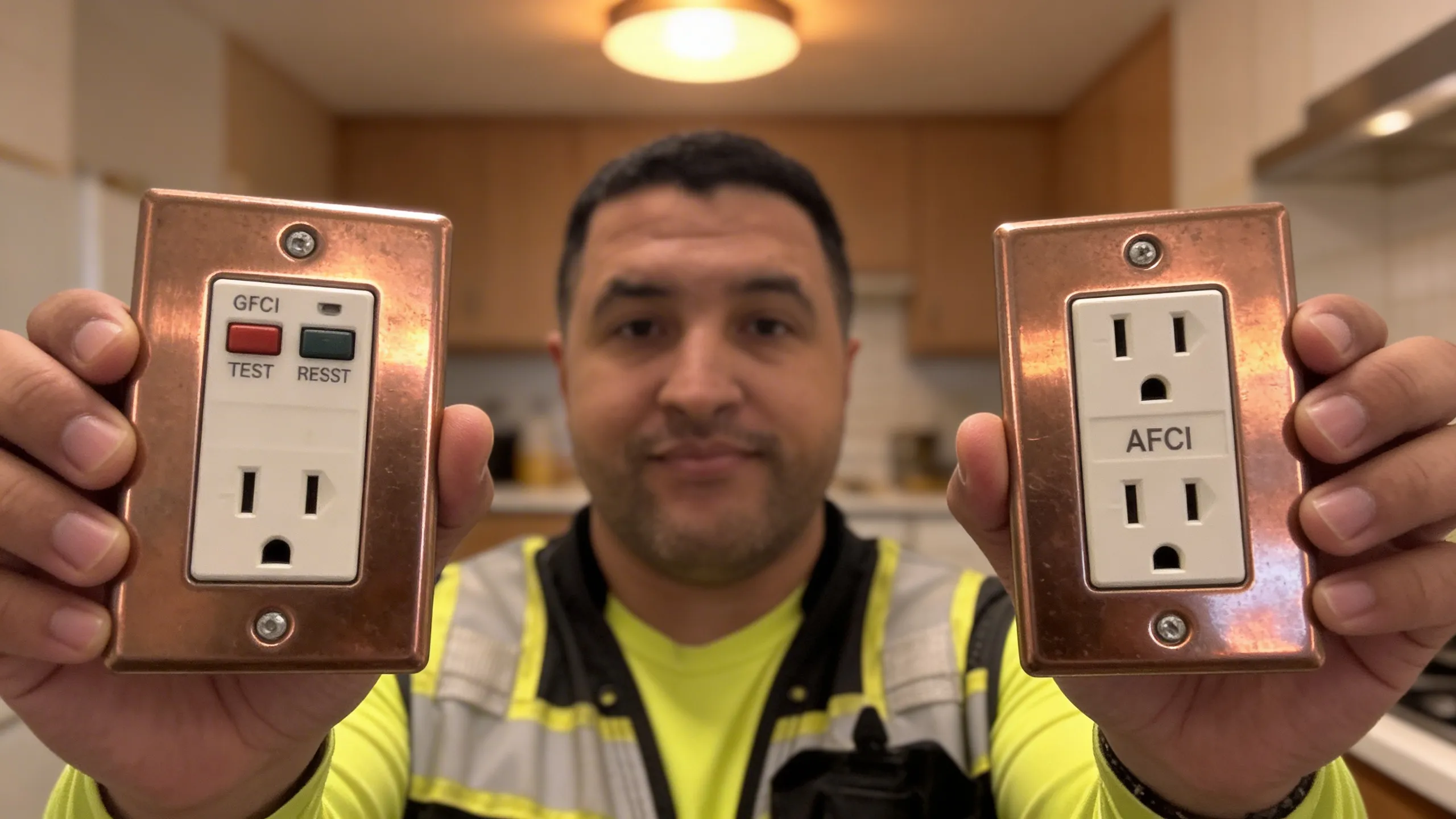
Most homeowners know the outlets with the TEST and RESET buttons. Those are GFCI outlets, and they have been required in bathrooms and kitchens for decades. Fewer homeowners know about AFCI protection — a newer technology that detects a completely different type of electrical hazard. Both are critical to home safety, they protect against different threats, and the current electrical code requires both in specific locations throughout your home.
This article breaks down how GFCI and AFCI protection work, where each is required, and when you should upgrade your existing outlets or breakers.
What Is a GFCI?
GFCI stands for Ground Fault Circuit Interrupter. Its job is to prevent electric shock. A GFCI continuously monitors the current flowing through the hot and neutral wires of a circuit. Under normal conditions, the current on both wires is equal — what goes out on the hot wire comes back on the neutral wire. If even a small amount of current (as little as 4 to 6 milliamps) leaks to ground — through water, through a metal surface, through a person — the GFCI detects the imbalance and shuts off the circuit in about 1/40 of a second.
That speed matters. It takes about 100 milliamps of current through the chest to cause cardiac arrest. A GFCI trips at 4 to 6 milliamps — well below the threshold that can kill you. Without GFCI protection, a ground fault through water (standing on a wet bathroom floor while touching a faulty hair dryer, for example) could be fatal.
Where GFCI Is Required
Under the current NEC (National Electrical Code), GFCI protection is required on all 125-volt, 15- and 20-amp outlets in the following locations:
- Bathrooms
- Kitchens (all countertop outlets within 6 feet of a sink)
- Garages and accessory buildings
- Outdoors
- Crawl spaces and unfinished basements
- Laundry areas
- Areas near sinks (within 6 feet)
- Boathouses
GFCI Outlet vs. GFCI Breaker
GFCI protection can be installed at the outlet (the familiar receptacle with TEST/RESET buttons) or at the breaker panel (a GFCI breaker that protects the entire circuit). Both methods are code-compliant. A GFCI breaker is more convenient when a single circuit feeds multiple outlets that all need protection — one breaker protects the whole run. A GFCI outlet is easier to install as a retrofit and lets you test the protection right where you use it.
What Is an AFCI?
AFCI stands for Arc-Fault Circuit Interrupter. Its job is to prevent electrical fires. An arc fault occurs when electricity jumps across a gap — a loose screw terminal, a cracked wire, a nail through a cable — and generates intense heat in a tiny area. Standard breakers do not detect arc faults because the overall current draw stays within the breaker's rating. The arcing is localized and intermittent, but hot enough to ignite wood, insulation, or paper inside a wall cavity.
An AFCI breaker uses electronic monitoring to detect the unique electrical signature of arcing — rapid, irregular fluctuations in the current waveform that differ from normal switching or motor startup patterns. When it detects arcing, it trips the circuit before a fire can start.
Where AFCI Is Required
The 2020 NEC (adopted in most metro Atlanta jurisdictions) requires AFCI protection on all 120-volt, 15- and 20-amp branch circuits supplying outlets and devices in the following areas:
- Bedrooms
- Living rooms and family rooms
- Dining rooms
- Hallways
- Closets
- Sunrooms
- Recreation rooms
- Kitchens and laundry areas (in the 2020 NEC and later)
In practice, AFCI protection is required on nearly every circuit in a new home except bathrooms, garages, and outdoors — which are already covered by GFCI requirements.
Pro Tip
Test your GFCI outlets monthly by pressing the TEST button. If the outlet does not trip and kill power, the GFCI has failed and needs replacement. A GFCI that does not trip cannot protect you from shock — and they do wear out over time, typically after 10-15 years.
GFCI vs AFCI: Side-by-Side Comparison
Here is a clear breakdown of how these two protection types differ:
- Threat protected against: GFCI protects against ground faults (shock). AFCI protects against arc faults (fire).
- How it detects the problem: GFCI monitors current balance between hot and neutral. AFCI monitors the current waveform for arc signatures.
- Trip speed: GFCI trips in about 25 milliseconds (1/40 second). AFCI trips in a fraction of a second when arcing is detected.
- Primary locations: GFCI in wet areas (bathroom, kitchen, garage, outdoor). AFCI in living areas (bedrooms, living rooms, hallways).
- Available as: GFCI is available as an outlet or a breaker. AFCI is available primarily as a breaker (AFCI outlets exist but are less common).
- Cost per unit: GFCI outlet: $15–$25. GFCI breaker: $40–$60. AFCI breaker: $35–$50.
Free Download: Seasonal Electrical Maintenance Checklist
Keep your home's electrical system safe year-round with our printable seasonal checklist — built by a master electrician.
Get the Free ChecklistDual-Function GFCI/AFCI Breakers
For locations that require both types of protection — kitchens and laundry rooms under the 2020 NEC — manufacturers offer dual-function breakers that combine GFCI and AFCI in a single device. Square D, Eaton, and Siemens all produce dual-function breakers that fit their respective panels.
Dual-function breakers cost $45 to $70 each — more than either individual type but less than installing both separately. They simplify compliance and reduce the number of devices in the panel. During a panel upgrade, installing dual-function breakers on circuits that need both protections is the most efficient approach.
When to Upgrade Your Existing Protection
Older Atlanta homes may have no GFCI protection at all, or GFCI only in the bathroom. AFCI protection was not required in Georgia until the 2008 NEC adoption (bedrooms only) and was expanded to most living areas under the 2014 and 2020 cycles. If your home was built before these dates and has not been updated, you may be missing one or both types of protection on critical circuits.
Upgrade Triggers
- Panel upgrade: When you upgrade your electrical panel, the inspector may require AFCI breakers on circuits that were previously grandfathered. This is the most natural time to add both GFCI and AFCI protection.
- Renovation: Any renovation that involves new wiring or extending existing circuits triggers current code requirements for the affected circuits.
- Failed GFCI outlets: GFCI outlets have a lifespan of about 10 to 15 years. If yours no longer trip when you press the TEST button, they need replacement immediately — a non-tripping GFCI provides zero shock protection.
- Recurring breaker trips: If a circuit breaker keeps tripping without an obvious overload, adding AFCI protection can help identify arc faults that a standard breaker misses.
Common Misconceptions
"GFCI outlets protect against fire."
They do not. GFCI outlets detect ground faults — current leaking to ground through water or a person. They do not detect arcing inside a wall. You need AFCI protection for fire prevention.
"AFCI breakers trip too often — they are too sensitive."
Early AFCI breakers (circa 2008-2012) had nuisance tripping issues with certain appliance motors and some types of LED dimmers. Modern AFCI breakers have improved significantly and distinguish between dangerous arcing and normal electrical noise much more reliably. If your AFCI breaker trips frequently, it may be detecting a real arc fault that warrants investigation — or it may need replacement with a current-generation unit.
"I have surge protectors, so I do not need GFCI or AFCI."
Surge protection guards against voltage spikes from lightning and utility switching. It does not detect ground faults or arc faults. Surge protectors, GFCI, and AFCI address three completely different threats. Your home benefits from all three.
Safety Warning
GFCI stops the shock. AFCI stops the fire. Surge protection stops the spike. They are not interchangeable — they are layers of protection, and each one covers a gap the others leave open.
Installation Costs in Metro Atlanta
Here are typical costs for GFCI and AFCI upgrades in the Atlanta area:
- GFCI outlet installation (per outlet): $125 – $200, including the outlet and labor
- GFCI breaker installation (per breaker): $150 – $250
- AFCI breaker installation (per breaker): $150 – $250
- Dual-function GFCI/AFCI breaker: $175 – $275 per breaker
- Whole-home upgrade during panel replacement: Included in the panel upgrade cost when breakers are selected as part of the project
At JD Works Electrical, we evaluate your current protection during every service call and recommend upgrades where the code or your safety warrants them. Contact us for a free assessment of your home's GFCI and AFCI coverage.
Frequently Asked Questions
Yes. Dual-function GFCI/AFCI circuit breakers provide both types of protection on a single circuit. These combination breakers are available from Square D, Eaton, and Siemens, and they satisfy code requirements for areas that need both GFCI and AFCI protection — such as kitchens and laundry rooms.
Test GFCI outlets once a month by pressing the TEST button. The outlet should lose power immediately. Then press RESET to restore power. If the outlet does not trip when you press TEST, or if it does not reset, the GFCI has failed and needs replacement. A failed GFCI provides no shock protection even though it may still deliver power.
Existing homes are generally grandfathered and not required to add AFCI protection unless you are doing a renovation involving new circuits or a panel upgrade. However, adding AFCI breakers is a smart safety investment — they detect arc faults that standard breakers miss entirely, and arc faults are a leading cause of residential electrical fires.
Is Your Home Protected?
JD Works Electrical installs and upgrades GFCI, AFCI, and dual-function breakers across metro Atlanta. We will assess your current protection and bring it up to code.
Schedule a Safety Assessment