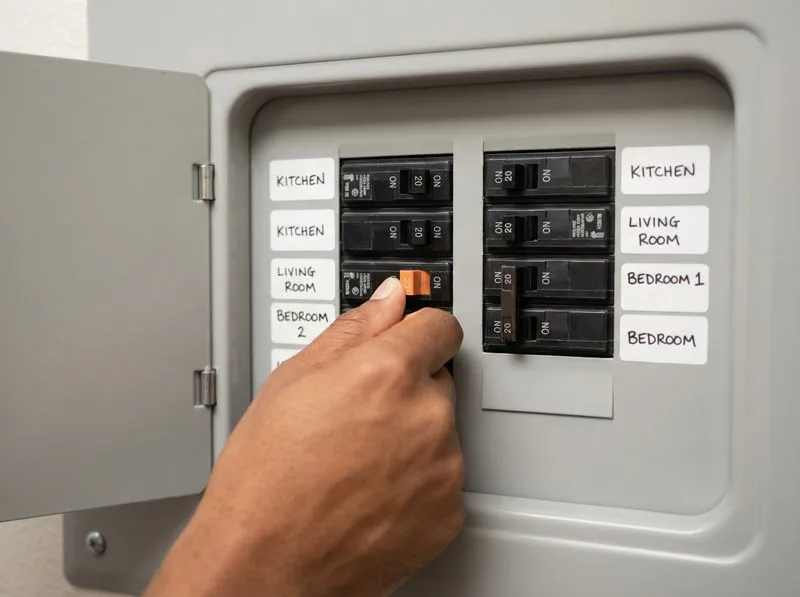
You are in the kitchen making dinner. The microwave is running, the toaster pops, and suddenly the kitchen goes dark. You walk to the garage, find the tripped breaker, flip it back, and return to cooking — until it happens again 10 minutes later. If this sounds familiar, you are not alone. Tripping circuit breakers are one of the most common electrical complaints I hear from homeowners in metro Atlanta.
A breaker that trips once is doing its job. A breaker that trips repeatedly is telling you something specific is wrong. The five causes below account for the vast majority of repeat trips. Understanding which one applies to your situation saves you time and helps you explain the problem to your electrician.
Cause 1: Circuit Overload
This is the most common reason a breaker trips. Every circuit in your home has a rated capacity — typically 15 amps (1,800 watts) or 20 amps (2,400 watts) for standard circuits. When the combined draw of everything plugged into that circuit exceeds the rating, the breaker trips to prevent the wiring from overheating.
In many older Atlanta homes, the kitchen has only one or two circuits feeding all the countertop outlets. A microwave draws about 1,200 watts. A toaster draws about 1,500 watts. Running both on a single 15-amp circuit demands 2,700 watts — well beyond the 1,800-watt rating. The breaker trips because the math does not work.
The fix for chronic overloads is adding circuits. A dedicated circuit for the microwave, another for the refrigerator, and a split circuit for the countertop outlets is the standard kitchen configuration in new construction. Retrofitting these circuits in an existing home costs $250 to $500 per circuit and requires a permit.
Cause 2: Short Circuit
A short circuit happens when a hot (energized) wire touches the neutral wire or the ground wire inside a junction box, outlet, switch, or appliance. This creates a path of near-zero resistance, which causes a massive spike in current — far more than the breaker's rating. The breaker trips instantly, sometimes with a visible spark or a popping sound at the panel.
Short circuits are caused by damaged wiring (a nail driven through a cable during construction or renovation), a faulty appliance with melted internal insulation, loose connections where wires have vibrated free of their terminals, or rodent damage to cable insulation in the attic or crawlspace.
You can narrow down the location by unplugging everything on the circuit and resetting the breaker. If it holds, plug devices back in one at a time. If it trips with nothing plugged in, the short is in the wiring itself — inside a wall, junction box, or fixture. That requires an electrician with a circuit tracer to locate and repair.
Cause 3: Ground Fault
A ground fault is similar to a short circuit, except the hot wire touches the ground wire or a grounded metal surface (like a junction box or an appliance chassis). Ground faults are especially common in wet locations — kitchens, bathrooms, garages, and outdoor outlets — where moisture can create conductive paths between the hot wire and grounded surfaces.
This is exactly the condition that GFCI outlets and breakers are designed to detect. A GFCI monitors the balance of current between the hot and neutral wires. If current is leaking to ground (through water, a metal surface, or a person), the GFCI detects the imbalance and trips in 1/40 of a second — fast enough to prevent electrocution.
If your standard breaker (not a GFCI breaker) keeps tripping on a kitchen or bathroom circuit, a ground fault is the likely cause. An electrician can test the circuit, find the fault, and install proper GFCI protection to prevent future issues.
Free Download: Seasonal Electrical Maintenance Checklist
Keep your home's electrical system safe year-round with our printable seasonal checklist — built by a master electrician.
Get the Free ChecklistCause 4: Worn or Faulty Breaker
Circuit breakers are mechanical devices with a finite lifespan. After thousands of on-off cycles and years of thermal stress, the internal bimetal strip or magnetic trip mechanism can lose calibration. A worn breaker may trip at lower currents than its rating — or, more dangerously, fail to trip when it should.
Nuisance tripping on a breaker that has been in service for 20 or more years is often a sign that the breaker itself needs replacement. This is a $150 to $300 repair for a standard breaker. If multiple breakers are failing, or if the panel is a known problem brand (Federal Pacific or Zinsco), a full panel upgrade is the better investment.
Cause 5: Arc Fault
An arc fault occurs when electricity jumps across a gap in a damaged or deteriorated wire. The arc generates intense, localized heat — enough to ignite insulation, wood framing, or other combustible materials inside a wall. Arc faults are a leading cause of electrical fires in residential buildings.
AFCI (Arc-Fault Circuit Interrupter) breakers are designed to detect the unique electrical signature of arcing and trip before a fire starts. The current NEC requires AFCI protection on most living-area circuits — bedrooms, living rooms, hallways, and closets. If your home was built before these requirements were adopted, your breakers may not detect arc faults at all.
Safety Warning
If a standard breaker trips and you cannot identify an overload, a short, or a ground fault, an arc fault in the wiring is a possibility — and it is the most dangerous of the five causes. Do not keep resetting the breaker. Call an electrician to trace the circuit and identify the arc source.
When to Call an Electrician
You can troubleshoot basic overloads yourself by redistributing loads across different circuits. But call a licensed electrician if:
- A breaker trips more than twice in a row after resetting
- The breaker will not stay in the ON position
- You smell burning near the panel or any outlet
- The breaker or the wires entering it feel hot to the touch
- You see scorch marks or discoloration on the breaker or panel
- The breaker trips with nothing plugged into the circuit
Any of these conditions indicates a problem beyond a simple overload. Continuing to reset the breaker without diagnosis risks fire, equipment damage, or shock. At JD Works Electrical, we diagnose tripping breakers daily across metro Atlanta — from Midtown condos to Gwinnett County ranches. Check our panel and breaker services for details.
Pro Tip
A tripping breaker is not a nuisance — it is a safety device doing its job. The question is not how to stop it from tripping. The question is what is making it trip, and how do you fix the root cause.
Preventing Future Breaker Trips
Once the immediate problem is resolved, several steps can prevent future trips:
- Map your circuits. Know which outlets and fixtures are on each breaker. Label the panel clearly.
- Spread heavy loads. Do not run two high-draw appliances on the same circuit simultaneously.
- Install dedicated circuits for appliances that draw 1,000 watts or more — microwaves, space heaters, window AC units, shop tools.
- Upgrade GFCI and AFCI protection to catch ground faults and arc faults before they trip your main breakers.
- Schedule an electrical inspection if your home is more than 25 years old. An electrician can identify overloaded circuits, worn breakers, and potential hazards before they become emergencies.
Frequently Asked Questions
Yes. Every time a breaker trips and you reset it without addressing the cause, you are forcing current through a circuit that is telling you something is wrong. Repeated tripping can damage the breaker itself, cause it to lose calibration, and increase the risk of an electrical fire. If a breaker trips more than twice in a row, stop resetting it and call a licensed electrician.
You are likely overloading the circuit. A standard 15-amp circuit can handle about 1,800 watts. If two appliances together exceed that limit — for example, a microwave and a toaster on the same circuit — the breaker trips. The solution is to use different circuits or install a dedicated circuit for the heaviest load.
The cost depends on the cause. Replacing a single faulty breaker costs $150 to $300. Splitting an overloaded circuit into two runs $300 to $600. Installing a new dedicated circuit costs $250 to $500. A full panel upgrade, if the panel itself is the problem, costs $1,800 to $3,500 in metro Atlanta.
Tired of Tripping Breakers?
JD Works Electrical diagnoses and fixes the root cause — not just the symptom. Serving homeowners across metro Atlanta.
Schedule a Diagnostic Visit