Atlanta is full of beautiful older homes — 1920s Craftsman bungalows in Inman Park, 1940s ranches in Decatur, 1960s split-levels in Tucker. The architecture has character. The electrical wiring, on the other hand, may be a liability. If your home is more than 40 years old and has never had its wiring updated, it is worth paying attention to the warning signs that something needs to change.
Electrical fires account for roughly 50,000 house fires each year in the United States. Most of them start inside walls, where deteriorated wiring and overloaded circuits generate heat that the homeowner never sees until it is too late. The good news: rewiring problems almost always give you warning before they become emergencies. Here are the five signs I see most often in Atlanta homes that need rewiring.
Sign 1: Flickering or Dimming Lights
A light that flickers when you turn on a hair dryer or a kitchen appliance is telling you something specific: the circuit cannot maintain stable voltage under load. This happens when the wiring is undersized for the current it is carrying, when connections have loosened over decades of thermal cycling (heating and cooling with use), or when the wire insulation has deteriorated to the point where current is leaking.
Occasional dimming during a thunderstorm or when the HVAC compressor kicks on is normal — those are momentary voltage dips from the utility side. But persistent dimming or flickering on a specific circuit, or across multiple circuits, points to a wiring issue inside your home. It means the conductors or connections are struggling, and struggling conductors generate heat.
If you notice this pattern, do not ignore it. Have an electrician trace the circuit and test the connections. Sometimes the fix is as simple as tightening a loose wire nut in a junction box. Other times, it reveals a section of degraded wiring that needs replacement. Either way, the diagnostic work is worth the cost.
Sign 2: Warm or Discolored Outlets and Switch Plates
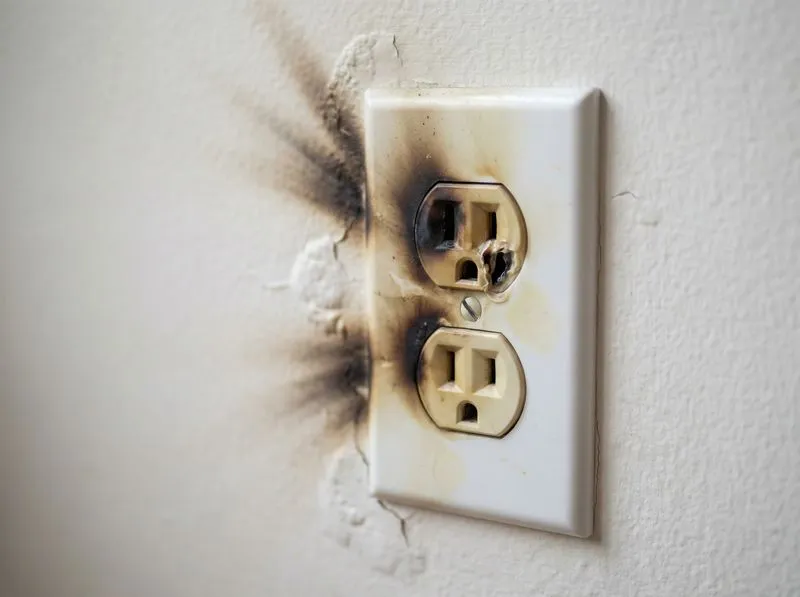
Touch your outlet and switch covers periodically. They should be room temperature. If a cover plate feels warm — or if you see brown or yellow discoloration on a white plate — that outlet is generating heat behind the wall. The causes include loose wire connections at the terminal screws, backstab connections that have lost tension (a chronic problem with cheap outlets), or a circuit that is pulling more current than the wiring was designed to handle.
Discoloration is especially telling. It means the heat has been building for a long time — long enough to change the color of the plastic. By the time you see scorch marks, the situation is urgent. Kill power to that circuit at the breaker and call an electrician the same day.
In homes with aluminum wiring, warm outlets are particularly common because aluminum connections loosen faster than copper as the metal expands and contracts. If your home was built between 1965 and 1975, check your outlets carefully — aluminum wiring was standard in that era.
Sign 3: Frequent Breaker Trips or Blown Fuses
Circuit breakers trip to prevent overloads. If a breaker trips once because you ran a space heater and a hair dryer on the same circuit, that is the breaker doing its job. Reset it, spread the load across different circuits, and move on.
But if the same breaker trips repeatedly under normal conditions — running the microwave, or just having the living room lights on — the circuit has a problem. It could be a short somewhere in the wiring, a degraded breaker that no longer holds its calibration, or an overloaded circuit that was never designed for the number of devices you are running on it.
Homes that still use fuse boxes face an additional risk: the temptation to install a higher-amperage fuse to stop the blowing. A 15-amp circuit with a 20-amp fuse will not blow as often, but the wiring will overheat because it is carrying more current than it was rated for. This is one of the most common fire hazards I encounter in older Atlanta homes. If your home has a fuse box, a panel upgrade should be at the top of your to-do list. Read more about why breakers trip for additional context.
Safety Warning
Never replace a blown fuse with a higher-amperage fuse. A 20-amp fuse on a 15-amp circuit does not fix the overload — it removes the protection. The wiring overheats, and the fuse that should have stopped it no longer will. This is one of the most common causes of electrical fires in older Atlanta homes.
Sign 4: Two-Prong Outlets and Missing Ground Wires
If your home still has two-prong outlets, the wiring behind those outlets almost certainly has no ground wire. Grounding is a safety feature that gives fault current a safe path back to the panel rather than through your body or your appliances. Every outlet in a modern home has a ground wire — the round hole at the bottom of a three-prong outlet connects to it.
Ungrounded circuits are a shock hazard and a surge hazard. They cannot support GFCI or AFCI protection properly (though GFCI outlets can be installed on ungrounded circuits with a "No Equipment Ground" label as an interim measure). They also cannot safely power electronics with three-prong plugs — using a cheater adapter defeats the ground and voids the protection.
Two-prong outlets are the most visible indicator that your wiring has not been updated since the home was built. They are also the easiest to notice. If you count more than a few two-prong outlets in your home, the wiring behind the walls is the original installation and should be evaluated by a licensed electrician.
Free Download: Seasonal Electrical Maintenance Checklist
Keep your home's electrical system safe year-round with our printable seasonal checklist — built by a master electrician.
Get the Free ChecklistSign 5: Burning Smell or Buzzing Sounds from Outlets
This is the most urgent warning sign. A burning smell near an outlet or switch plate — even if you cannot see visible damage — means something is overheating inside the wall. The smell comes from melting wire insulation, smoldering wood framing, or arcing at a connection point. Any of these can cause a fire.
Buzzing or crackling sounds from an outlet, switch, or the breaker panel carry the same urgency. The sound is caused by electricity arcing across a gap — a loose connection, a cracked wire, or a failing breaker. Arcing generates intense heat in a very small area, and it can ignite surrounding materials in seconds.
If you smell burning or hear buzzing, do not wait. Turn off the breaker for that circuit immediately. If you cannot identify which breaker controls it, turn off the main breaker. Then call an electrician for an emergency visit. This is not a next-week problem — it is a right-now problem.
What Kind of Wiring Does Your Home Have?
Understanding what wiring is in your walls helps you assess the urgency. Here is a quick reference by construction era for Atlanta homes:
- Before 1950: Likely knob-and-tube wiring — ungrounded, single-insulated conductors on porcelain insulators. This wiring is a fire risk when buried under insulation or when the rubber insulation deteriorates.
- 1950–1965: Early NM (Romex) cable with cloth-covered insulation. The copper conductors are usually fine, but the cloth insulation becomes brittle and crumbles, especially in hot attics.
- 1965–1975: Possible aluminum branch circuit wiring. Aluminum connections loosen over time and create fire hazards at outlets and switches.
- 1975–present: Modern NM-B (Romex) cable with PVC insulation. This wiring holds up well, but homes from the late 1970s and early 1980s may still have undersized circuits by today's standards.
What Does Rewiring Involve?
A full rewire replaces the wiring from the electrical panel to every outlet, switch, and light fixture in the home. The electrician typically runs new cable through the attic and drops it down into the walls, minimizing the amount of drywall that needs to be opened. In single-story ranch homes — common across Cobb, Gwinnett, and DeKalb counties — attic access makes the job faster and less disruptive.
The scope includes replacing the electrical panel if it is undersized or outdated, upgrading all outlets to grounded three-prong receptacles, adding GFCI protection in kitchens, bathrooms, and garages, and installing AFCI-protected breakers where required by current code. Each circuit gets properly sized wiring — 12-gauge for 20-amp kitchen and bathroom circuits, 14-gauge for 15-amp general lighting circuits.
A full rewire for a 2,000-square-foot home typically takes 3 to 5 days, depending on the complexity of the floor plan and the accessibility of the walls and attic. Permits and inspections are required in all metro Atlanta jurisdictions.
Safety Warning
The wiring in your walls does not last forever. The copper might, but the insulation around it has a shelf life — and in Atlanta's heat, that shelf life is shorter than you think. If your home is over 40 years old, get it inspected. What you do not know can hurt you.
When Partial Rewiring Makes Sense
Not every home needs a complete rewire from scratch. If the main wiring runs are in good condition but specific circuits — the kitchen, the bathroom, or a bedroom with backstab outlets — show signs of trouble, targeted rewiring addresses the problem areas without the cost and disruption of a whole-house project.
Partial rewiring is also a practical approach when budget is a constraint. You can prioritize the highest-risk circuits first and schedule additional phases over time. Each phase requires its own permit, but the cumulative cost is manageable and the most dangerous conditions get addressed immediately.
Frequently Asked Questions
A full rewire for a typical 1,500 to 2,500 square-foot Atlanta home runs between $8,000 and $20,000, depending on the number of circuits, accessibility of walls and attic spaces, and whether the electrical panel also needs an upgrade. Partial rewiring — replacing only the most damaged or dangerous circuits — costs less and is sometimes the practical first step.
There is no single expiration date for electrical wiring. Copper wiring in good condition with intact insulation can last 50 to 70 years. However, the insulation around the wire degrades faster — especially in hot attics common in Atlanta. If your home was built before 1970 and has never been rewired, a professional inspection is strongly recommended.
Yes. Phased rewiring is a common approach for Atlanta homeowners who want to spread the cost over time. An electrician can prioritize the highest-risk areas — typically kitchens, bathrooms, and bedrooms — and rewire those first while leaving less critical circuits for later phases. Each phase requires its own permit and inspection.
Concerned About Your Home's Wiring?
JD Works Electrical offers thorough wiring inspections and rewiring services across metro Atlanta. We will tell you exactly what needs attention — and what can wait.
Schedule a Wiring Inspection