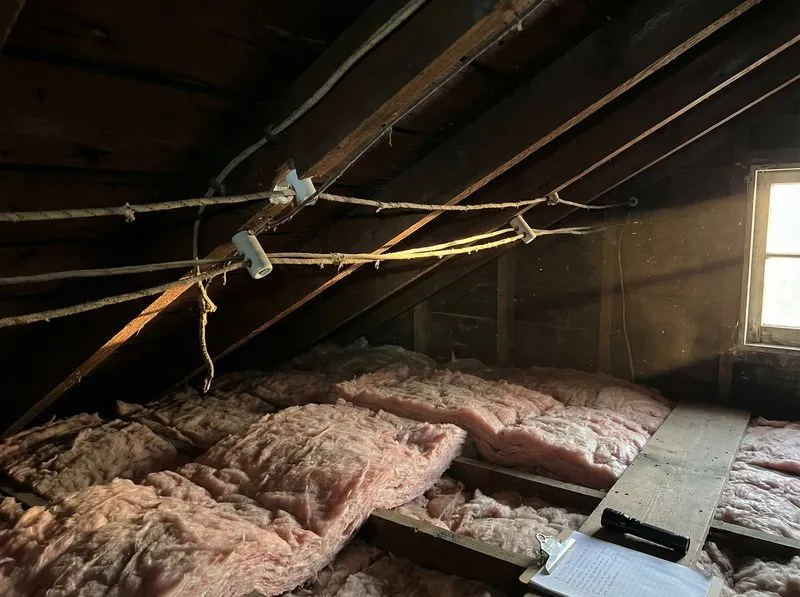
Knob and tube wiring was the standard electrical installation method in American homes from about 1880 through the late 1940s. In metro Atlanta, that means you will find it in pre-war bungalows in Grant Park, Virginia-Highland, Candler Park, and parts of Decatur — neighborhoods where the housing stock dates to the 1920s and 1930s. The wiring worked fine for the homes it was designed for. The problem is that those homes now have air conditioning, kitchen appliances, computers, and electrical loads that knob and tube was never built to carry.
If you own or are buying an older Atlanta home, understanding knob and tube wiring — what it looks like, why it fails, and what your options are — can save you from a dangerous situation and a very expensive surprise.
What Is Knob and Tube Wiring?
Knob and tube (K&T) is an early wiring method that uses individual copper conductors — one hot, one neutral — run through porcelain knobs mounted to structural framing and porcelain tubes where wires pass through joists and studs. The conductors are insulated with a rubberized cloth that was durable when new but deteriorates over decades.
Unlike modern NM (Romex) cable, knob and tube has no ground wire. The hot and neutral conductors are run separately, spaced several inches apart, which was an early form of heat dissipation. There is no protective sheath bundling the wires together.
You can identify K&T wiring by looking in your attic or basement. The white porcelain knobs — about the size of a doorknob — are mounted to joists and rafters, with the wire looped around them. Porcelain tubes (cylindrical sleeves) protect the wire where it passes through wood framing. If you see these components, you have knob and tube wiring on at least some of your circuits.
Why Knob and Tube Wiring Is Dangerous
Insulation Breakdown
The rubber and cloth insulation on K&T wiring breaks down over time. In Atlanta's hot summers, attic temperatures can exceed 140 degrees Fahrenheit. That heat accelerates the degradation of rubber insulation, causing it to become brittle, crack, and eventually crumble away. When the insulation fails, bare copper conductors are exposed — and bare copper touching wood framing is an ignition source.
No Ground Wire
Knob and tube circuits have no ground wire. In a fault condition — a hot wire touching a metal appliance chassis, for example — there is no safe path for the current to return to the panel and trip the breaker. Instead, the fault current waits for a person to touch the appliance and complete the circuit through their body. This is a shock hazard that modern grounded wiring eliminates.
Overloading
K&T circuits were designed for lighting loads — a few bulbs per circuit, totaling 5 to 10 amps. Modern households routinely draw 15 to 20 amps per circuit for outlets, appliances, and electronics. Overloaded K&T wiring runs hotter than it was designed for, and the heat accelerates the insulation degradation described above. It is a compounding problem: the more you load it, the faster it fails.
Insulation Contact
K&T wiring was designed to dissipate heat into open air — the wires are separated and run through open joist bays. When homeowners add blown-in insulation to attics and walls (for energy efficiency), the insulation buries the K&T conductors and traps heat around them. This is one of the most common fire hazards associated with knob and tube wiring, and it violates the National Electrical Code.
Safety Warning
Never add blown-in insulation to an attic or wall cavity that contains knob and tube wiring. Burying K&T conductors in insulation traps heat around the wires and is one of the leading causes of knob-and-tube-related house fires. If insulation already covers K&T wiring, have an electrician assess the risk.
Improper Modifications
Over 80 to 100 years, K&T circuits have often been spliced into, extended, and modified by homeowners and unlicensed handymen. I have found electrical tape splices in attics, wire nuts connecting K&T to modern Romex without junction boxes, and circuits that were extended to feed outlets and loads they were never designed for. Each modification adds another failure point.
Insurance and Real Estate Implications
In Georgia, many homeowners insurance carriers will not write a policy for a home with active knob and tube wiring. State Farm, Allstate, and several other major carriers either decline coverage or require a licensed electrician to certify that the K&T wiring has been de-energized or replaced before they will bind the policy.
If you are buying a home with K&T wiring, your home inspector should identify it. Your lender may require remediation before closing. And your insurance options will be limited and more expensive until the wiring is replaced.
If you are selling a home with K&T wiring, expect buyers to request a wiring credit or a price reduction. Having the wiring replaced before listing removes the biggest red flag on the inspection report and makes the home insurable at standard rates. Check our guide on signs your home needs rewiring for a broader view of wiring red flags.
Free Download: Seasonal Electrical Maintenance Checklist
Keep your home's electrical system safe year-round with our printable seasonal checklist — built by a master electrician.
Get the Free ChecklistReplacement Options
Full Replacement
The most thorough option is removing all knob and tube wiring and replacing it with modern NM-B cable. This involves running new cable from a new or upgraded electrical panel to every outlet, switch, and fixture in the home. The old K&T wiring is disconnected and left in place (removing it from inside walls is usually impractical without demolition).
Full replacement gives you grounded circuits, proper GFCI and AFCI protection, code-compliant circuit sizing, and a modern panel. It solves the insurance problem completely and adds real value to the home.
Partial Replacement
If budget is a constraint, partial replacement targets the most problematic circuits first. Kitchens, bathrooms, and bedrooms are typically the priority — they carry the highest loads and have the most stringent code requirements. The remaining K&T circuits can be left in service temporarily as long as they are not buried in insulation and the insulation on the conductors is intact.
Partial replacement requires careful documentation of which circuits have been replaced and which have not. Each phase needs its own permit and inspection. Over two or three phases, you can bring the entire home up to modern standards without a single large expense.
Interim Safety Measures
If replacement is not immediately possible, several measures can reduce the risk:
- Do not add insulation around K&T wiring. If blown-in insulation already covers K&T conductors in the attic, consider having it removed from around the wires.
- Do not overload K&T circuits. Avoid plugging high-draw appliances (space heaters, window AC units, hair dryers) into circuits fed by K&T wiring.
- Install GFCI outlets. GFCI outlets can be installed on ungrounded K&T circuits with a "No Equipment Ground" label. This does not add a ground wire, but it does provide shock protection.
- Have an electrician inspect accessible K&T wiring annually. Check for crumbling insulation, scorched wood, improper splices, and overheating.
These measures buy time, but they are not substitutes for replacement. The underlying problems — no ground, deteriorating insulation, undersized circuits — remain until the wiring is replaced.
What the Replacement Process Looks Like
In most Atlanta bungalows and cottages, the attic provides access to run new cable from the panel to the walls. The electrician drops new NM cable from the attic down through wall cavities to reach outlet and switch boxes. In some cases, small access holes are cut in the walls (typically at the top or bottom) and patched afterward.
For single-story homes with accessible attics — the standard layout in many of Atlanta's older neighborhoods — a full K&T replacement takes 4 to 7 days. Two-story homes and homes with plaster walls and no accessible attic space take longer and cost more because the electrician has to work through finished walls.
The project includes a new panel (most K&T homes still have a fuse box or undersized panel), new outlets throughout the home, GFCI protection in wet areas, and AFCI protection on bedroom circuits per current code. Permits and inspection are required and included in any reputable electrician's quote.
Pro Tip
Knob and tube wiring did its job for decades. It was well-engineered for the loads it was designed to carry. The issue is that we now ask it to power a completely different kind of home. Respecting what it was while recognizing what it cannot do — that is the responsible approach.
Choosing an Electrician for K&T Replacement
Not every electrician has experience with knob and tube wiring. The splicing methods, the routing patterns, and the quirks of pre-war construction require specific knowledge. When hiring for a K&T replacement, ask how many K&T jobs the electrician has done, ask for references from similar projects, and confirm they will pull a permit and schedule the county inspection.
At JD Works Electrical, we have replaced knob and tube wiring in homes across Fulton, DeKalb, and Cobb counties. We handle the full scope — assessment, panel upgrade, new wiring, permits, and inspection — and we leave a clean, clearly labeled panel that an inspector will sign off on the first visit. View our rewiring services or contact us for a free assessment.
Frequently Asked Questions
Knob and tube wiring is not illegal to have in your home. Existing K&T wiring is grandfathered under building codes. However, it cannot be extended, modified, or connected to new circuits under current Georgia electrical codes. If you renovate a room or add circuits, the K&T wiring in that area must be replaced with modern NM cable.
Some insurers will cover homes with K&T wiring, but many major carriers in Georgia either decline coverage or charge significantly higher premiums. Having a licensed electrician inspect the system can help, but full replacement is the only way to eliminate the insurance issue entirely.
Replacing knob and tube wiring in a typical Atlanta bungalow or cottage costs between $8,000 and $16,000, depending on the home's size, number of circuits, and how accessible the walls and attic are. This includes new NM cable, updated outlets, a panel upgrade if needed, permits, and inspection.
Have Knob and Tube Wiring? Let's Talk.
JD Works Electrical inspects and replaces knob and tube wiring in older Atlanta homes. We will assess your system and give you a clear, honest recommendation.
Request a K&T Wiring Assessment