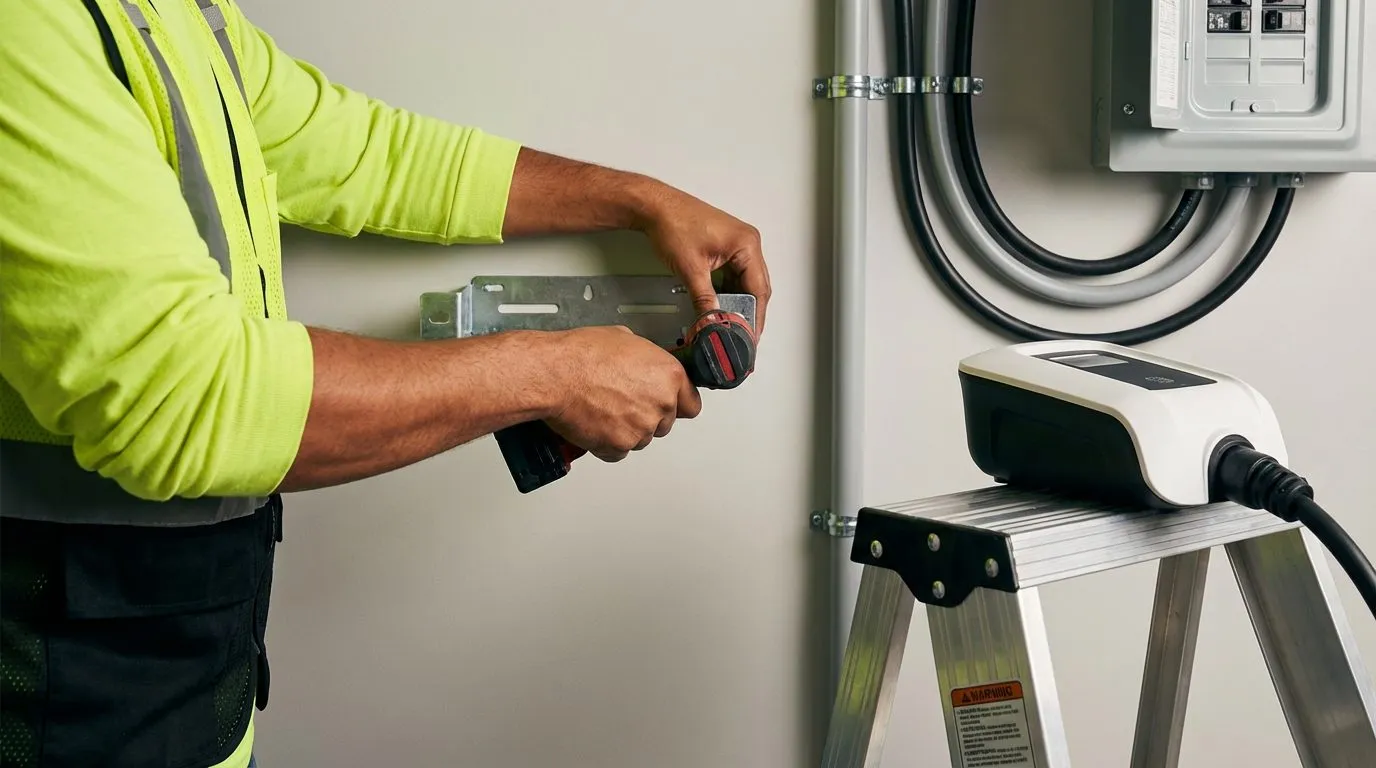
Electric vehicle adoption in Georgia is accelerating. The Georgia Department of Revenue reported more EV registrations in 2025 than the previous three years combined, and the Atlanta metro area accounts for the largest share. If you recently bought an EV or are planning to, you are probably already tired of using public charging stations and wondering what it takes to charge at home.
Home charging is the most convenient and cost-effective way to keep your EV battery topped off. But it requires proper electrical infrastructure — the right circuit, the right panel capacity, and the right charger for your vehicle and driving habits. This guide walks through the full process, from understanding charging levels to what happens on installation day.
Understanding Charging Levels
Level 1: Standard Household Outlet
Every EV comes with a Level 1 charging cord that plugs into a standard 120-volt outlet — the same outlet you use for lamps and phone chargers. Level 1 charging delivers about 3 to 5 miles of range per hour. For a 30-mile daily commute, that means 6 to 10 hours of charging every night. For longer commutes or larger batteries, Level 1 is painfully slow.
Level 1 works if you drive fewer than 30 miles per day and can dedicate a full overnight charge. For everyone else, Level 2 is the practical choice.
Level 2: 240-Volt Dedicated Circuit
Level 2 charging uses a 240-volt circuit — the same voltage as your electric dryer or range. A Level 2 charger delivers 25 to 40 miles of range per hour, depending on the amperage. A typical 40-amp charger adds about 30 miles per hour. A 48-amp charger adds about 37 miles per hour. For a 30-mile daily commute, you need about 1 hour of charging. For a fully depleted 60 kWh battery, 7 to 9 hours.
Level 2 is the standard for home EV charging. It is fast enough for overnight charging of any consumer EV, and the installation cost is reasonable relative to the daily convenience.
Level 3: DC Fast Charging
Level 3 (DC fast charging) can charge a battery from 10% to 80% in 20 to 40 minutes, but it requires industrial-grade power (480 volts, 100+ amps) and costs $50,000 or more to install. It is not practical for residential use. You will find Level 3 stations at highway rest stops, shopping centers, and dedicated charging stations — not in garages.
Electrical Requirements for Level 2 Charging
A Level 2 EV charger requires a dedicated 240-volt circuit with its own breaker in the panel — the same type of dedicated circuit used for home offices and other high-draw equipment, but at higher amperage. Here are the key specifications:
- Circuit amperage: Most Level 2 chargers draw 32 to 48 amps of continuous load. The NEC requires the circuit to be rated at 125% of the continuous load, so a 40-amp charger needs a 50-amp breaker, and a 48-amp charger needs a 60-amp breaker.
- Wire gauge: A 50-amp circuit requires 6-gauge copper wire. A 60-amp circuit requires 6-gauge or 4-gauge depending on the run length. Longer runs from the panel to the garage require heavier wire to compensate for voltage drop.
- Outlet type: Hardwired installations connect directly to the charger. Plug-in installations use a NEMA 14-50 outlet (the same outlet used for electric ranges) or a NEMA 6-50. Hardwired is slightly more reliable; plug-in is portable if you move.
- Panel capacity: The EV circuit adds 40 to 60 amps of demand to your panel. If you have a 200-amp panel with room, this is straightforward. If you have a 100-amp panel, the EV charger may consume 25 to 50 percent of your total capacity. A panel upgrade may be necessary before the charger can be installed.
Does Your Panel Have Enough Capacity?
This is the most important question in the entire EV charger installation process. Your electrician performs a load calculation (per NEC Article 220) to determine your home's total electrical demand and compare it to the panel's rated capacity.
Important
Never install an EV charger on a circuit shared with other equipment. The NEC requires a dedicated circuit for EV charging, and the circuit must be rated at 125% of the charger's continuous draw. A 40-amp charger needs a 50-amp breaker — no exceptions.
200-Amp Panels
Most homes with 200-amp panels have sufficient capacity for a Level 2 EV charger without any modifications. The charger gets a dedicated 50-amp breaker, and the panel still has plenty of headroom for the rest of the house. This is the typical scenario for homes built after 1990 in metro Atlanta.
100-Amp Panels
Homes with 100-amp panels — common in older neighborhoods across Decatur, East Atlanta, and parts of Cobb County — usually do not have sufficient capacity for an EV charger without a panel upgrade. A 50-amp EV circuit on a 100-amp panel leaves only 50 amps for everything else in the house: HVAC, water heater, kitchen appliances, lighting, and electronics. The load calculation will almost always show that a 200-amp upgrade is needed first.
Alternatives to a Full Panel Upgrade
If a panel upgrade is not immediately feasible, two alternatives can make EV charging work on a smaller panel:
- Load management devices: Smart panels and load management switches can temporarily shed non-critical loads (like the water heater or dryer) while the EV charges, freeing up panel capacity. This adds $200 to $600 in equipment cost but avoids a $2,000+ panel upgrade.
- Lower-amperage charger: A 24-amp Level 2 charger (like the Tesla Mobile Connector on a NEMA 14-30 outlet) requires only a 30-amp circuit and adds about 18 miles of range per hour. It is slower but may fit within a 100-amp panel's capacity for overnight charging.
Free Download: Seasonal Electrical Maintenance Checklist
Keep your home's electrical system safe year-round with our printable seasonal checklist — built by a master electrician.
Get the Free ChecklistChoosing the Right EV Charger
The charger market has matured significantly. Here are the key factors:
Amperage
Higher amperage means faster charging. A 32-amp charger adds about 25 miles per hour. A 48-amp charger adds about 37 miles per hour. For most Atlanta commuters driving 30 to 60 miles daily, a 40-amp charger provides overnight recovery with room to spare. If you drive more or have a larger battery (80+ kWh), the 48-amp charger is worth the extra cost.
Hardwired vs. Plug-In
Hardwired chargers connect permanently to the electrical circuit. They are slightly more reliable (no plug connection to loosen or corrode) and look cleaner. Plug-in chargers connect to a NEMA 14-50 or 6-50 outlet and can be unplugged and taken with you if you move. Both are code-compliant. I recommend hardwired for permanent installations and plug-in for renters or homeowners who may relocate.
Smart Features
Most modern chargers offer Wi-Fi connectivity, smartphone apps, scheduled charging (to take advantage of Georgia Power's lower overnight rates), energy monitoring, and load sharing for homes with two EVs. Smart chargers from brands like ChargePoint, Grizzl-E, Emporia, and JuiceBox cost $50 to $150 more than basic units and are worth it for the scheduling feature alone — Georgia Power's time-of-use rates can save you $20 to $40 per month by shifting charging to off-peak hours.
Indoor vs. Outdoor Rated
If the charger mounts in a garage, an indoor-rated (NEMA 3R or better) unit works fine. If it mounts on an exterior wall — common when the panel is on the opposite side of the house from the garage — you need an outdoor-rated (NEMA 4) charger that handles rain, humidity, and Atlanta's summer heat. Most quality chargers are rated for both indoor and outdoor use. Check our guide on outdoor electrical installations for more on weatherproof requirements, and see our article on outdoor electrical for additional considerations when running circuits to exterior locations.
The Installation Process
Step 1: Site Assessment
I visit the home, inspect the panel, perform a load calculation, and identify the best route for the circuit from the panel to the charger location. The ideal setup is a panel in the garage with the charger mounted on the adjacent wall — a short wire run, minimal cost. The most expensive setups involve running wire from a panel on one side of the house to a charger on the other side, through the attic or crawlspace.
Step 2: Permit
An electrical permit is required in all metro Atlanta jurisdictions for a new 240-volt circuit. I pull the permit as part of the project and schedule the inspection after installation. The permit ensures the work meets the current NEC and protects you as the homeowner.
Step 3: Circuit Installation
The new circuit runs from the panel to the charger location. In a garage installation with the panel nearby, this may be as simple as 10 to 15 feet of wire in conduit along the garage wall. In longer runs, the wire routes through the attic, crawlspace, or wall cavities. A dedicated 50-amp breaker is installed in the panel, and the circuit is tested for proper voltage, polarity, and ground.
Step 4: Charger Mounting and Connection
The charger mounts to the wall at a comfortable height — typically 42 to 48 inches from the floor, with the cord reaching the vehicle's charging port without excessive tension. For hardwired units, the charger connects directly to the circuit. For plug-in units, the NEMA outlet is installed and the charger plugs in.
Step 5: Testing and Walkthrough
The charger is powered on, tested with the vehicle, and I walk you through the operation — including how to use scheduled charging if the unit supports it. The county inspection follows within a few days.
Installation Costs in Metro Atlanta
Here are realistic cost ranges for EV charger installation in the Atlanta area as of 2026:
- Basic installation (panel in garage, short run): $500 – $800
- Standard installation (moderate wire run, 30-50 feet): $800 – $1,200
- Complex installation (long run through attic/crawlspace, 50+ feet): $1,200 – $1,800
- Panel upgrade required (add to above): $1,800 – $3,500
- Charger unit (not included in above): $300 – $700 for most brands
These prices include labor, wire, conduit, breaker, permit, and inspection. Some charger manufacturers and Georgia Power offer rebates or incentives — ask your electrician or check Georgia Power's website for current programs.
Georgia Power Rates and EV Charging Costs
Georgia Power offers a Plug-In EV rate plan with lower overnight pricing. Under the time-of-use structure, electricity costs roughly 1 cent per kWh during super off-peak hours (11 PM to 7 AM) compared to 7 to 20 cents during peak hours. Charging a 60 kWh battery overnight on the super off-peak rate costs about $0.60 — compared to $4 to $12 during peak hours.
A smart charger with scheduling capability lets you take full advantage of these rates by programming the charger to start automatically at 11 PM every night. Over a year, the savings add up to $500 or more compared to unscheduled charging.
Future-Proofing Your Installation
EV technology is moving fast. Here are a few ways to future-proof your installation:
- Install a 60-amp circuit even if your current charger only draws 40 amps. The wire and breaker cost a few dollars more, but you will not need to rewire when you upgrade to a faster charger.
- Run conduit. Even if you are pulling wire through conduit now, the conduit makes it easy to pull larger wire later without opening walls or ceilings.
- Plan for two vehicles. If your household may add a second EV, run two circuits now (or at least run two conduits) while the walls and panels are accessible.
Pro Tip
The best time to install an EV charger is before you need one urgently. Plan the circuit, plan the panel capacity, and plan for the future. A well-done installation today saves you from a costly redo tomorrow.
EV-Ready vs. EV-Installed
If you are building a new home or doing a major renovation, consider having the circuit pre-wired to the garage even if you do not own an EV yet. This is called an "EV-ready" installation — the wire and breaker are in place, and all that is needed when you buy an EV is mounting the charger and connecting it. Pre-wiring during construction or renovation costs 30 to 50 percent less than a retrofit because the walls are already open and the electrician is already on site. While the walls are open, it is also the ideal time to plan your recessed lighting layout and run any other new circuits you may need.
At JD Works Electrical, we install Level 2 EV chargers across metro Atlanta — from Buckhead to McDonough, Marietta to Snellville. We handle the load calculation, panel evaluation, permit, installation, and inspection. Whether you need a simple garage-wall install or a full panel upgrade with a long-distance run, we will give you a clear quote before any work begins. See our EV charger installation services or request a free estimate.
Frequently Asked Questions
A Level 2 EV charger installation in metro Atlanta typically costs between $500 and $1,500 for the electrical work, not including the charger unit ($300–$700). If you need a panel upgrade to accommodate the new 50-amp circuit, add $1,800 to $3,500 for the panel work. Contact us for a specific quote based on your home's setup.
A Level 2 EV charger requires a dedicated 240-volt circuit, typically 40 or 50 amps. If your panel is a 200-amp panel with available breaker spaces, adding an EV circuit is straightforward. If you have a 100-amp panel, you will likely need a panel upgrade first. An electrician can perform a load calculation to determine your current capacity.
A Level 2 charger delivering 30 to 50 amps adds approximately 25 to 40 miles of range per hour. For a typical daily commute of 30 to 40 miles, you can fully replenish overnight in 1 to 2 hours. A full charge on a depleted 60 kWh battery takes roughly 6 to 10 hours depending on the charger amperage.
Ready to Charge at Home?
JD Works Electrical installs Level 2 EV chargers across metro Atlanta. We handle the load calculation, panel assessment, permit, installation, and inspection — start to finish.
Get a Free EV Charger Installation Quote