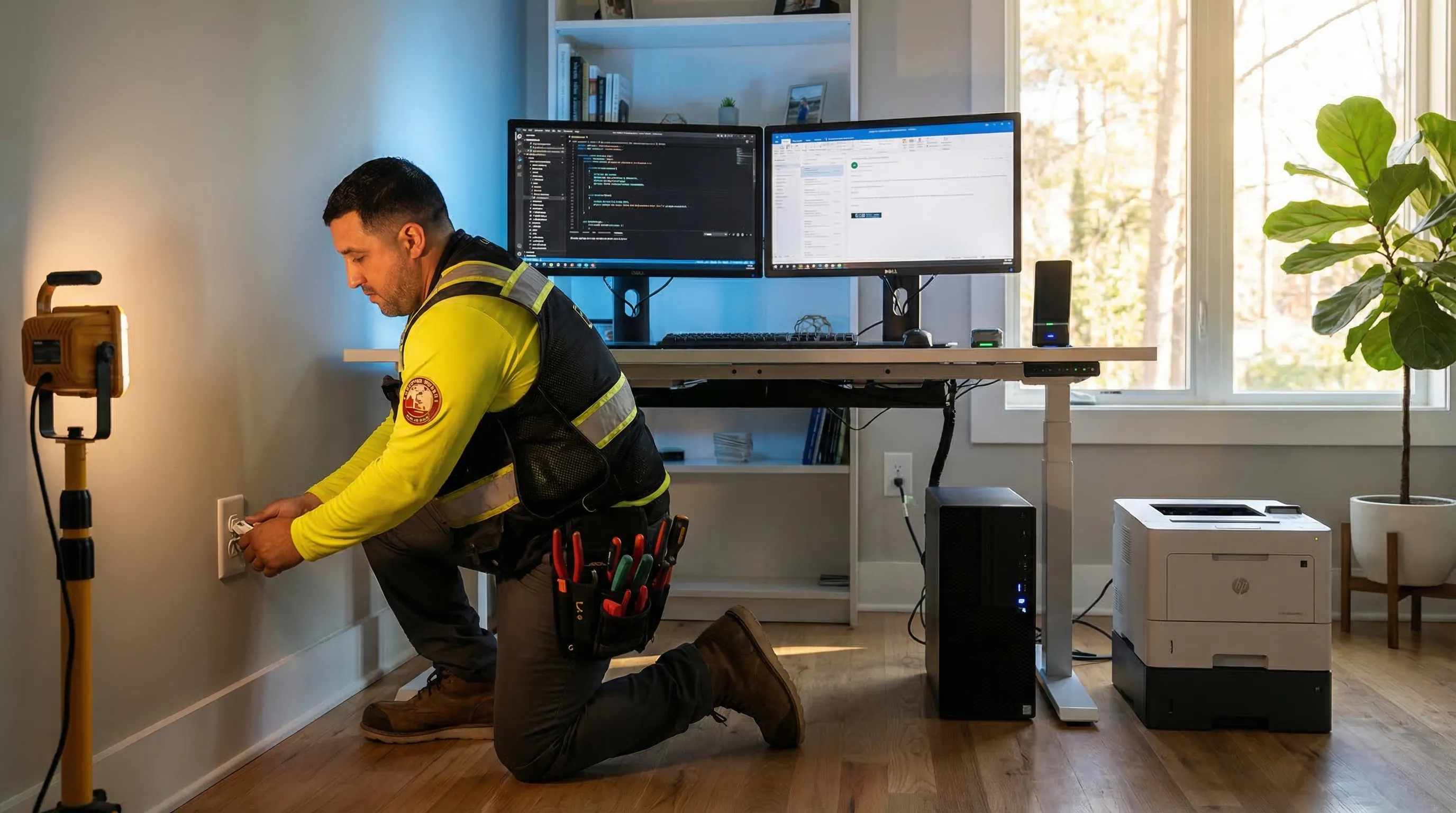
Your home office setup probably looks something like this: laptop, external monitor, desk lamp, printer, phone charger, maybe a space heater in the winter. All of it plugged into two wall outlets that share a 15-amp circuit with the hallway lights and the bedroom next door. Then the breaker trips during a video call with a client, your screen goes black, and you lose 20 minutes of unsaved work.
This isn't a freak occurrence. It's what happens when a circuit built for a 1990s guest bedroom gets asked to power a 2026 remote office. A dedicated circuit — a single circuit that runs from your electrical panel directly to your office — solves the problem permanently. Here's how it works and when you actually need one.
What a Dedicated Circuit Actually Is
Every circuit in your home starts at the electrical panel and runs through a specific path of wires to a group of outlets, lights, or appliances. Most bedroom and living room circuits in Atlanta homes serve 4 to 8 outlets plus overhead lights, all sharing one 15-amp breaker. That's 1,800 watts of total capacity split across everything connected to that circuit.
A dedicated circuit is different. It runs a single cable from an open breaker slot in your panel directly to one outlet or one area — your home office. Nothing else shares that wire. The full 20 amps (2,400 watts on a 120V circuit) belong to your office equipment alone.
The National Electrical Code already requires dedicated circuits for specific appliances: refrigerators, dishwashers, microwaves, washing machines, and bathroom outlets. The logic is the same for a home office — high-draw equipment that runs for extended periods deserves its own protected circuit.
Safety Warning
Never daisy-chain power strips or plug one power strip into another. This bypasses the built-in overload protection and creates a serious fire hazard. If you need more outlets than your room provides, you need a dedicated circuit — not more power strips.
Signs Your Home Office Needs a Dedicated Circuit
Not every home office needs a new circuit. If you're running a laptop and a phone charger, the existing bedroom circuit probably handles it fine. But if any of these situations sound familiar, you've outgrown your wiring:
- The breaker trips when you turn on specific equipment. If running the printer while the monitor and space heater are on pops the breaker, the circuit is overloaded. Learn more about why this happens in our guide to circuit breaker tripping causes.
- Lights dim when the printer or laser jet fires up. Laser printers draw a brief surge of 10-15 amps during warmup. If your hallway lights flicker at the same moment, the printer and lights share a circuit that can't handle the spike.
- You use a space heater in your office. A 1,500-watt space heater alone consumes 12.5 amps — over 80% of a 15-amp circuit's capacity. There's barely enough headroom left for a laptop charger, let alone a full workstation.
- You've daisy-chained power strips. Multiple power strips plugged into each other are a fire hazard and a sign that the room doesn't have enough circuit capacity for the equipment it contains.
- You run a desktop computer with a high-wattage power supply. Gaming PCs and workstations with dedicated graphics cards can draw 500-800 watts under load. Add a monitor, speakers, and peripherals, and you're pushing 1,000 watts on the desk alone.
What Installation Involves
Adding a dedicated circuit to a home office is one of the most common residential electrical jobs we do in Atlanta. Here's the typical process:
- Panel inspection. The electrician checks your main panel for an open breaker slot. Most 200-amp panels (the standard in homes built after 2000) have spare slots. Older 100-amp or 150-amp panels may be full, which means a panel upgrade comes first.
- Wire routing. A new 12-gauge cable (required for 20-amp circuits) runs from the panel through the wall cavity or attic to the office. In single-story homes with attic access above the office, this takes 1-2 hours. In finished basements or multi-story homes where the panel is far from the office, routing takes longer.
- Outlet installation. A new 20-amp duplex receptacle gets installed in the office wall. The electrician may also install a quad outlet (four plugs instead of two) to reduce the need for power strips.
- Breaker installation and labeling. A new 20-amp breaker goes into the panel, the circuit gets labeled, and the electrician tests everything with a meter to verify proper voltage, grounding, and polarity.
The whole job usually takes half a day. No drywall demolition required in most cases — the wire runs through existing wall cavities and attic space.
Free Download: Seasonal Electrical Maintenance Checklist
Keep your home's electrical system safe year-round with our printable seasonal checklist — built by a master electrician.
Get the Free ChecklistDedicated Circuit vs. Surge Protector: Know the Difference
Homeowners sometimes confuse these two solutions because both involve "protecting" electronics. They solve completely different problems.
A surge protector guards against voltage spikes — the brief, high-voltage events caused by lightning strikes, utility switching, or large motors cycling on and off. It does nothing to prevent overload trips. A dedicated circuit provides additional amperage capacity so your equipment doesn't exceed the circuit's limit. It does nothing to stop voltage spikes.
For a properly protected home office, you want both: a dedicated 20-amp circuit for capacity, and a quality surge protector (or whole-home surge protection device at the panel) for spike protection.
Pro Tip
If your electrician is already running a dedicated circuit to your office, have them pull a Cat6 Ethernet cable through the same wall cavity at the same time. Hardwired internet is faster and more reliable than Wi-Fi for video calls, and the added labor cost is minimal when the walls are already being accessed.
Smart Home and Future-Proofing Considerations
While the electrician is already at your panel running wire to the office, it's worth considering additional upgrades that share the same labor cost:
- Ethernet drop: Running a Cat6 cable alongside the electrical wire gives your office a hardwired internet connection — faster and more reliable than Wi-Fi for video calls and large file transfers.
- USB outlets: 20-amp receptacles with built-in USB-A and USB-C ports eliminate charger clutter on the desk.
- Smart switch for overhead lighting: If you're adding a smart home wiring setup, the office is a natural starting point. A smart dimmer on the ceiling light lets you adjust brightness for screen work vs. reading without leaving your chair.
When a Dedicated Circuit Isn't Enough
If your panel is already full — no open breaker slots — a single dedicated circuit isn't an option without first creating space. The solutions, in order of scale:
- Tandem breakers: Some panels accept tandem (slim) breakers that fit two circuits into one slot. Not all panels support them, and local code limits how many you can use.
- Sub-panel: A small sub-panel (60 or 100 amps) installed near the office provides multiple new circuit slots fed by a single cable from the main panel.
- Full panel upgrade: If the main panel is a 100-amp unit from the 1980s or earlier, upgrading to a 200-amp panel is the long-term answer. This creates room for the home office circuit plus future needs like an EV charger or additional kitchen circuits.
Frequently Asked Questions
A dedicated circuit is a single electrical circuit that serves only one outlet or appliance. Your home office needs one because computers, monitors, printers, and other equipment can overload a shared circuit — especially in older Atlanta homes where a bedroom circuit also powers hallway lights and other rooms.
A single dedicated 20-amp circuit typically costs between $200 and $500 in metro Atlanta, depending on how far the new wire must run from the panel and whether the panel has open breaker slots. If the panel is full, a sub-panel or panel upgrade may be needed first.
A power strip adds outlets but does not increase circuit capacity. If a 15-amp circuit is already near its limit, plugging a power strip into it just distributes the same limited amperage across more devices. A surge protector strip protects against voltage spikes but cannot prevent overload trips. Only a dedicated circuit from the panel provides additional capacity.
Stop Losing Work to Tripped Breakers
JD Works Electrical installs dedicated home office circuits across metro Atlanta. Same-week scheduling available for most jobs.
Request a Free Estimate