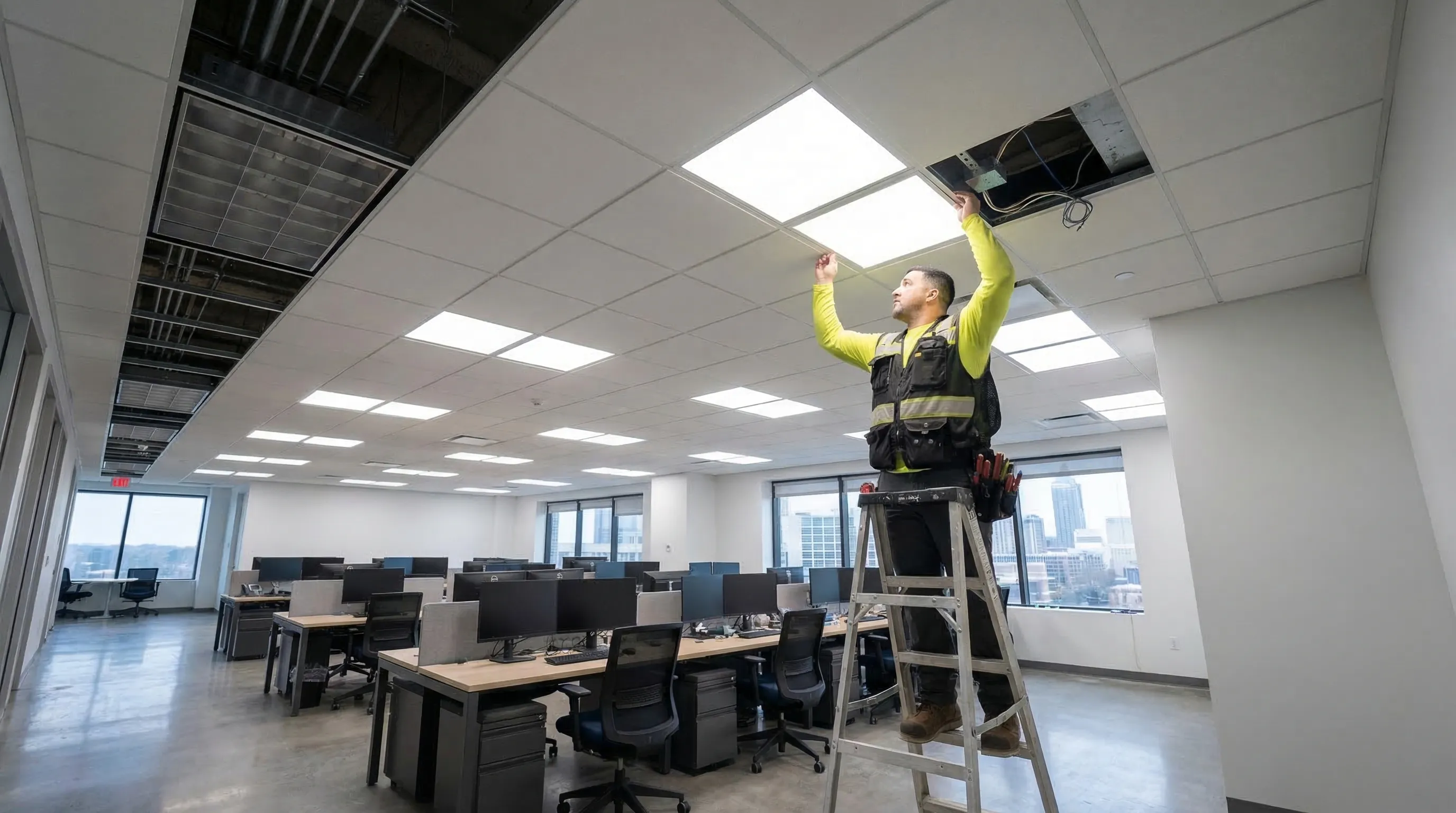
Walk into most Atlanta office buildings, retail stores, and warehouses built before 2015 and you'll see the same thing overhead: rows of 4-foot fluorescent troffers buzzing away at 32 watts per tube. Four tubes per fixture, 50 fixtures per floor, running 10-12 hours a day. The electricity bill for lighting alone in a 10,000-square-foot commercial space can run $400-$800 per month at Georgia Power's commercial rate. An LED retrofit cuts that number by 40-70% — and the fixtures last three to five times longer.
This isn't theoretical. It's math. And the payback period on most commercial LED upgrades in Atlanta runs 12 to 24 months, after which the savings go straight to your bottom line. Here's how the three main retrofit approaches work, what each costs, and how to choose the right one for your building.
Three Approaches to Commercial LED Retrofits
Type A: Plug-and-Play LED Tubes
Type A LED tubes are designed to work with existing fluorescent ballasts. You pull the old fluorescent tube out, slide the LED tube in, and you're done. No wiring changes, no electrician required for the swap itself (though a licensed electrician should verify ballast compatibility beforehand).
Pros:
- Lowest upfront cost per fixture — typically $8-$15 per tube
- Fastest installation — one person can swap 100+ tubes in a day
- No wiring modifications, no permit required
Cons:
- The old ballast stays in the fixture, consuming 3-5 watts of parasitic power
- When the ballast fails (and it will — ballasts last 50,000-75,000 hours), the entire fixture goes dark until the ballast is replaced or bypassed
- Not all LED tubes are compatible with all ballast types — instant-start, programmed-start, and magnetic ballasts each require different tube specifications
Type A makes sense when you need a fast, low-cost upgrade and the existing ballasts are relatively new (under 5 years old). For buildings with older ballasts, Type B or full replacement is the better investment.
Type B: Ballast Bypass LED Tubes
Type B tubes connect directly to line voltage (120V or 277V), bypassing the ballast entirely. An electrician rewires each fixture to route power straight to the lamp holders, then removes or disconnects the ballast. The LED tube runs on line voltage from that point forward.
Pros:
- Eliminates the ballast as a failure point and energy consumer
- Higher efficiency than Type A (no parasitic ballast draw)
- Tube replacement in the future is straightforward — any compatible Type B tube works
Cons:
- Requires an electrician to rewire each fixture — adds $15-$30 per fixture in labor
- Line voltage is present at the lamp holders, creating a shock risk if someone installs a fluorescent tube in a Type B fixture by mistake (mitigated by labeling the fixture)
Type B is the most popular choice for commercial retrofits where the building owner plans to keep the existing fixture housings. It strikes the best balance between cost, efficiency, and long-term reliability.
Important
After a Type B ballast bypass, line voltage is present at the lamp holders. If someone accidentally installs a fluorescent tube in a bypassed fixture, the tube can shatter or cause a shock. Always label every bypassed fixture clearly to prevent this.
Full Fixture Replacement
This approach removes the old fluorescent troffer entirely and installs a new LED panel or troffer in its place. Modern LED troffers are flat, thin, and produce excellent light quality with a high Color Rendering Index (CRI of 80-90+).
Pros:
- Best light quality — even distribution, no shadows, no flicker
- Highest efficiency — purpose-built LED fixtures outperform retrofit tubes
- Longest lifespan — 100,000+ hours for premium LED troffers
- Modern appearance that improves the look of the workspace
Cons:
- Highest upfront cost — $80-$200 per fixture plus installation labor
- More disruptive to install — ceiling tiles come down, old fixtures come out, new fixtures mount and wire in
Full replacement makes the most sense when the existing fixtures are 15+ years old, visibly deteriorated, or when the space is undergoing a renovation anyway. If you're already doing a tenant improvement buildout, rolling a lighting upgrade into the construction scope is the most cost-effective approach.
ROI Calculation: A Real Example
Here's a simplified example for a 5,000-square-foot Atlanta office with 80 fluorescent fixtures (4 tubes each, 320 total tubes):
- Current consumption: 320 tubes x 32 watts = 10,240 watts. Running 11 hours/day, 260 days/year = 29,286 kWh/year.
- LED consumption (Type B): 320 LED tubes x 15 watts = 4,800 watts. Same hours = 13,728 kWh/year.
- Annual savings: 15,558 kWh x $0.11/kWh (Georgia Power commercial) = $1,711/year.
- Retrofit cost (Type B): 320 tubes x $12 = $3,840 + 80 fixtures x $25 labor = $2,000. Total: $5,840.
- Payback period: $5,840 / $1,711 = 3.4 years.
After year 3.4, that $1,711 annual savings flows directly to the bottom line — for the next 7-10 years of LED tube life. Factor in reduced maintenance costs (no more ballast replacements, no more re-lamping every 2-3 years), and the effective payback drops below 3 years.
Color Temperature for Commercial Spaces
Commercial LED lighting typically runs at higher color temperatures than residential. The common choices:
- 3500K (neutral white): The standard for offices and retail. Professional appearance without the harshness of higher temperatures.
- 4000K (cool white): Popular in healthcare, manufacturing, and commercial kitchens where task visibility matters.
- 5000K (daylight): Used in warehouses, garages, and industrial spaces where maximum visibility is the priority and aesthetics are secondary.
For retail environments, CRI (Color Rendering Index) matters as much as color temperature. A CRI of 90+ ensures that merchandise colors look accurate under artificial light. Cheap LED tubes with CRI below 80 make everything look flat and washed out — bad for a clothing store or restaurant.
For residential lighting choices, see our guide on recessed lighting layout which covers color temperature selection for homes.
Free Download: Seasonal Electrical Maintenance Checklist
Keep your home's electrical system safe year-round with our printable seasonal checklist — built by a master electrician.
Get the Free ChecklistRebates and Incentives
Georgia Power offers commercial energy efficiency rebates through its Commercial Energy Efficiency Program. LED lighting upgrades qualify for prescriptive rebates based on the wattage reduction per fixture. The rebate amounts change periodically, so check Georgia Power's current program details or ask your electrician to include rebate information in the project proposal.
Federal tax incentives under the Energy Efficient Commercial Buildings Deduction (Section 179D) may also apply to commercial LED retrofits that achieve sufficient energy reduction. Consult your accountant for eligibility — the deduction can be significant for large-scale projects.
Pro Tip
LED retrofits are one of the few building improvements that pay for themselves in measurable energy savings. Every month you wait is money leaving the building through the meter.
Frequently Asked Questions
Most commercial LED retrofits reduce lighting energy consumption by 40-70% compared to fluorescent or HID systems. For a 5,000-square-foot office running 100 fluorescent tubes at Georgia Power commercial rates, that translates to roughly $1,500-$3,000 in annual savings depending on operating hours and the specific fixtures replaced.
Yes, using Type A (plug-and-play) LED tubes that work with existing ballasts. You remove the fluorescent tube and insert the LED tube — no wiring changes needed. The trade-off is that the old ballast continues to consume some energy and will eventually fail. Type B (ballast bypass) tubes require rewiring the fixture to remove the ballast but eliminate this issue.
For a plug-and-play tube swap in a typical office or retail space, an electrician can replace 50-100 tubes in a single day. Ballast bypass retrofits take longer — roughly 30-50 fixtures per day. Full fixture replacements are the most time-intensive, typically 20-30 fixtures per day per electrician. We schedule commercial lighting work during off-hours to avoid disrupting your business.
Ready to Cut Your Lighting Costs?
JD Works Electrical performs commercial LED retrofits across metro Atlanta. We'll audit your current lighting, calculate savings, and handle the entire installation.
Request a Free LED Lighting Audit