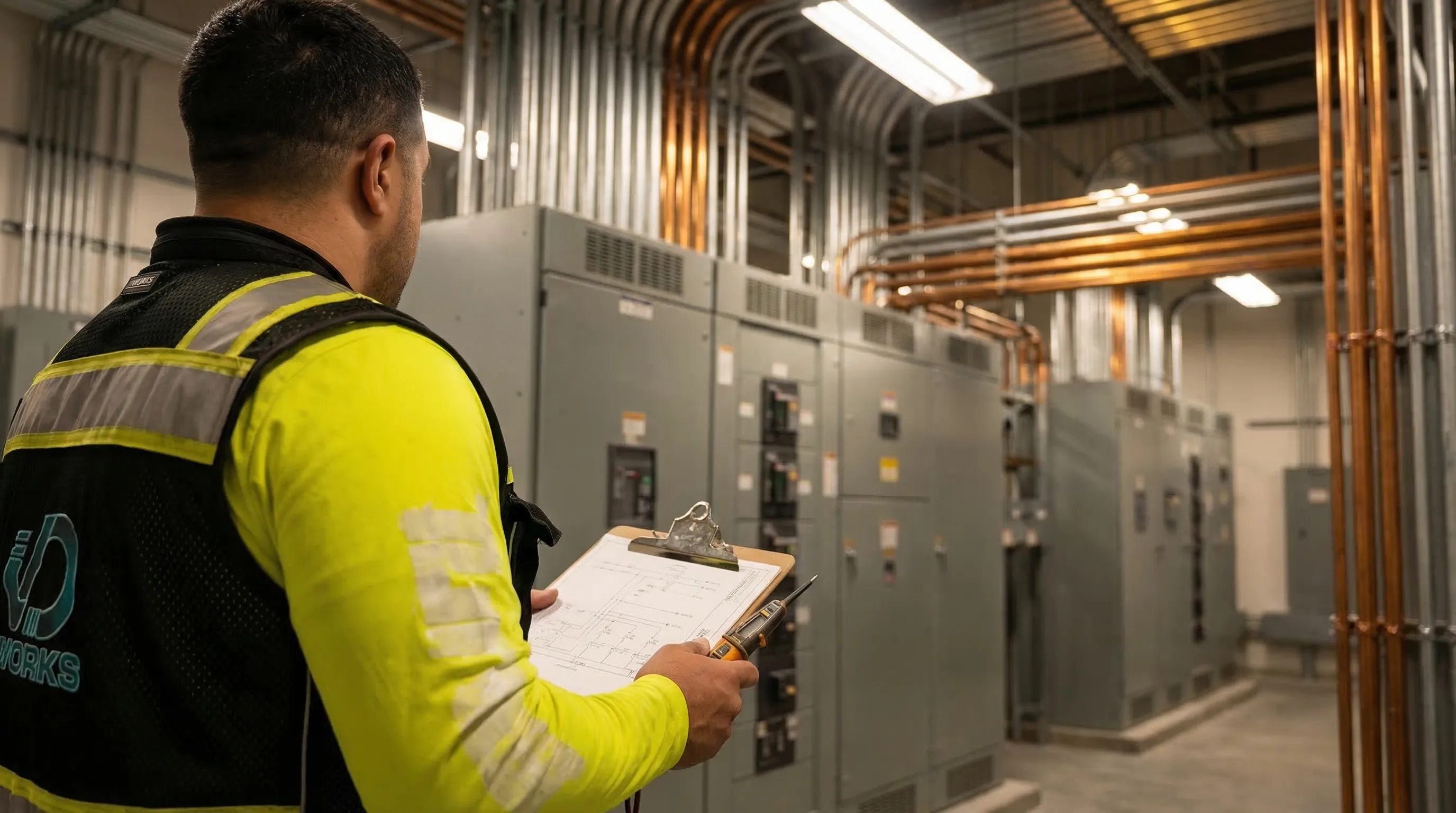
Running a business in Atlanta means managing a building — and managing a building means dealing with electrical systems that residential contractors weren't trained to handle. Three-phase power distribution, commercial panel boards rated at 400 amps or more, fire alarm circuits, emergency lighting, and code requirements that change depending on your occupancy classification. The electrical infrastructure behind a restaurant kitchen in Midtown is nothing like the wiring in a house in Decatur.
This guide covers the full range of commercial electrical services that Atlanta business owners encounter — from the routine maintenance that prevents problems to the emergency repairs that solve them at 2 AM. Whether you own a retail storefront on Peachtree, manage an office building in Buckhead, or operate a warehouse in the Westside industrial corridor, these are the electrical services and decisions that affect your bottom line.
How Commercial Electrical Differs from Residential
The fundamental difference is scale and complexity. Residential electrical systems typically operate on single-phase 120/240V power delivered through a 200-amp main panel. Commercial buildings often run three-phase 120/208V or 277/480V power through multiple panel boards, transformers, and distribution equipment rated at 600 amps or higher.
That difference matters because:
- Three-phase power serves large motors, HVAC equipment, commercial kitchen appliances, and industrial machinery that can't run on single-phase residential power.
- Higher voltage (277V/480V) feeds commercial lighting, rooftop HVAC units, and elevator systems. Working on these circuits without commercial training and proper PPE is dangerous.
- Code requirements diverge. The NEC has separate articles for commercial occupancies — Article 517 for healthcare, Article 518 for assembly spaces, Article 520 for theaters, Article 550 for mobile structures. Each adds requirements beyond the residential baseline.
- Permitting and inspection processes are more involved. Commercial projects in Atlanta require plan review by the building department before construction begins, which residential projects often don't.
Safety Warning
Commercial electrical systems operate at voltages up to 480V — more than enough to kill on contact. Never attempt commercial electrical troubleshooting without proper training, PPE, and a Georgia unrestricted electrical contractor license. A residential electrician's experience does not cover three-phase power, commercial panel boards, or high-voltage distribution.
A residential electrician who installs ceiling fans and kitchen outlets isn't necessarily qualified for commercial work. Look for a contractor with specific commercial experience and a Georgia unrestricted electrical contractor license. At JD Works Electrical, we handle both — see our full services page for details.
Commercial Panel Upgrades and Power Distribution
The electrical panel is the heart of any commercial building's power system. When the panel can't keep up with demand, the symptoms show up everywhere: tripping breakers during peak hours, flickering lights when the HVAC cycles on, equipment that won't start because available voltage has sagged below operating range.
When a Commercial Panel Upgrade Is Necessary
- Adding new equipment. A new commercial oven, walk-in cooler, or HVAC unit may require more amperage than the existing panel can provide. Before installing new equipment, have an electrician perform a load calculation to confirm capacity.
- Expanding the space. Leasing additional square footage in the same building means more circuits for lighting, outlets, and HVAC — all of which pull from the same service entrance.
- Upgrading from fuses to breakers. Some older Atlanta commercial buildings — especially those built before 1970 in areas like Downtown, Grant Park, and East Atlanta — still have fuse-based panel boards. Modern circuit breakers offer better protection, faster response to faults, and easier reset after a trip.
- Code compliance. An electrical inspection may reveal that the existing panel doesn't meet current code — insufficient grounding, missing arc-fault protection in required locations, or outdated equipment that's been discontinued by the manufacturer.
A commercial panel upgrade typically takes 1-3 days depending on the scope. We schedule the heavy work — the service disconnect and panel swap — during off-hours to minimize disruption to your operations.
Commercial LED Lighting Upgrades
Lighting accounts for 17-25% of total electricity consumption in a typical commercial building, according to the U.S. Department of Energy. For an Atlanta office or retail space paying Georgia Power's commercial rate, that's a significant line item. Switching from fluorescent or HID fixtures to LED reduces energy consumption by 40-70% and cuts maintenance costs because LED lamps last 50,000-100,000 hours versus 20,000 for fluorescents.
The three most common commercial LED upgrade paths:
- Tube replacement (Type A): LED tubes that drop directly into existing fluorescent fixtures. Lowest upfront cost, but you're keeping the old ballast, which still consumes some energy and will eventually fail.
- Ballast bypass (Type B): LED tubes that wire directly to line voltage, bypassing the ballast entirely. Moderate cost, eliminates the ballast as a failure point.
- Full fixture replacement: Removing the old fluorescent troffer and installing a new LED panel or troffer. Highest upfront cost, but best light quality, highest efficiency, and longest lifespan. This is the option that makes the most sense for buildings where the existing fixtures are 15+ years old.
Read our detailed guide on commercial LED lighting upgrades for a deeper breakdown of each approach, including ROI calculations.
Electrical Code Compliance for Atlanta Commercial Properties
Code compliance isn't optional for commercial buildings. The City of Atlanta adopts the NEC (currently the 2023 edition with Georgia amendments) as the minimum standard for electrical installations. Failure to comply creates three risks:
- Failed inspections that delay occupancy permits, tenant move-ins, and business openings.
- Insurance liability. If a fire or injury is traced to non-compliant wiring, your commercial property insurance may deny the claim.
- Fines and legal exposure. The City of Atlanta's Office of Buildings can issue stop-work orders and fines for unpermitted or non-compliant electrical work.
Common code compliance issues we find in Atlanta commercial buildings include:
- Missing or non-functional emergency lighting and exit signs
- Overloaded circuits in tenant spaces that were never designed for the current use
- Electrical panels with insufficient working clearance (the NEC requires 36 inches of clear space in front of panels up to 600V)
- Missing GFCI protection in commercial kitchens, restrooms, and outdoor receptacles
- Outdated wiring in buildings that have changed occupancy type — a former warehouse converted to a restaurant has vastly different electrical code requirements
Our code compliance guide covers what Atlanta commercial property owners need to know about inspections, common violations, and how to get a building up to standard.
Free Download: Seasonal Electrical Maintenance Checklist
Keep your home's electrical system safe year-round with our printable seasonal checklist — built by a master electrician.
Get the Free ChecklistTenant Improvement Electrical Work
When a new tenant moves into a commercial space, the electrical system almost always needs modification. A dental office replacing a previous hair salon occupant needs different circuits, different lighting, different outlet placement, and dedicated power for X-ray equipment and sterilizers. An open-plan coworking space replacing a traditional office with private rooms needs the partition walls removed and the circuits reconfigured.
Tenant improvement (TI) electrical work typically includes:
- Demolition of existing circuits and fixtures in the old layout
- New circuit installation per the new floor plan
- Lighting relocation and replacement
- Data and communication wiring (structured cabling)
- Dedicated circuits for specialty equipment
- Code-required updates (bringing the space up to current NEC for the new occupancy type)
The permitting process for TI electrical work in Atlanta requires submitted plans showing the proposed electrical layout, load calculations, and panel schedules. The building department reviews these before issuing a permit, and a final inspection happens before the tenant can occupy the space. We walk through the full process in our tenant improvement electrical guide.
Emergency Commercial Electrical Repair
A residential power outage means a dark house and a warm refrigerator. A commercial power outage means lost revenue, spoiled inventory, stranded customers, and potentially life-safety system failures. When a breaker panel fails at a restaurant during Friday dinner service, or a short circuit kills the lights in a retail store during peak hours, the response has to be fast.
Emergency commercial electrical repair differs from residential emergency work in several ways:
- Three-phase troubleshooting. A single-phase loss on a three-phase system causes motors to run on two phases, which overheats and destroys them quickly. Diagnosing which phase dropped — and why — requires equipment and training beyond residential scope.
- Life-safety systems. Commercial buildings have fire alarm circuits, emergency lighting, elevator power, and dedicated egress lighting circuits. Any of these can trigger an emergency call when they malfunction.
- Revenue impact. Every hour of downtime costs money. A commercial electrician who can diagnose the problem in 30 minutes instead of 3 hours saves the business owner thousands in lost revenue.
JD Works Electrical provides emergency electrical repair for both residential and commercial clients across metro Atlanta. For commercial emergencies, we prioritize response because we understand what downtime costs you.
Preventive Maintenance for Commercial Electrical Systems
The best emergency is the one that never happens. Commercial electrical preventive maintenance catches failing components before they cause outages, fires, or equipment damage. A structured maintenance program includes:
Annual Tasks
- Infrared thermographic scanning: A thermal camera scan of panel boards, disconnects, and junction boxes reveals overheating connections that are invisible to the eye. A loose lug running 40 degrees above ambient is a fire waiting to happen.
- Breaker testing: Commercial breakers should be exercised (tripped and reset) annually. Breakers that sit closed for years can seize and fail to trip during an actual fault.
- Emergency lighting and exit sign testing: NFPA 101 (Life Safety Code) requires monthly 30-second functional tests and an annual 90-minute battery discharge test for all emergency lighting. Most Atlanta fire marshals check for documentation of these tests during inspections.
Every 3-5 Years
- Full electrical inspection: A comprehensive walk-through of every panel, junction box, receptacle, and fixture in the building. This is the time to catch code violations, deteriorated wiring, and equipment nearing end of life.
- Load study: An electrician measures actual current draw on each circuit over a period of time to identify overloaded circuits, unbalanced phases, and underutilized capacity.
- Arc flash study (for 480V systems): OSHA requires employers to assess arc flash hazards and label equipment with incident energy levels. An arc flash study determines the personal protective equipment (PPE) required to work on each piece of equipment safely.
Choosing the Right Commercial Electrician in Atlanta
Not all electricians are equal, and the differences matter more in commercial work where the stakes are higher. Here's what to evaluate:
- License type. Georgia issues restricted and unrestricted electrical contractor licenses. An unrestricted license covers all commercial work. A restricted license limits the contractor to certain types of projects. Verify the license at the Georgia Secretary of State's website.
- Insurance. Require a Certificate of Insurance showing general liability (minimum $1 million per occurrence) and workers' compensation coverage. If an uninsured electrician is injured in your building, the liability falls on you as the property owner.
- Commercial references. Ask for 3-5 references from commercial projects similar to yours. Call them. Ask about quality, timeline adherence, and communication.
- Permitting track record. A contractor who routinely pulls permits and passes inspections on the first try will save you weeks of delays compared to one who cuts corners.
- Emergency availability. Ask about after-hours response. If the electrician doesn't offer emergency service, you'll be calling a stranger at midnight when something fails.
Pro Tip
The cheapest bid on a commercial electrical project is almost never the best value. Rework, failed inspections, and unreliable equipment cost more in the long run than hiring the right contractor from the start.
Common Commercial Electrical Projects in Atlanta
Beyond the major categories above, here are the specific projects we handle most frequently for Atlanta businesses:
- Parking lot and interior lighting — LED pole lights, wall packs, and photocell-controlled circuits
- Electric vehicle charging station installation — Level 2 commercial chargers for employee and customer parking
- Cooking-hood circuits and commercial kitchen equipment lines — Dedicated power for restaurant equipment
- Fire alarm circuit installation and repair — New installations, troubleshooting ground faults, and device replacement
- Data center and server room power — Dedicated circuits, UPS integration, and redundant power feeds
- Commercial kitchen electrical — High-amperage circuits for ovens, fryers, hoods, and refrigeration
- Sign and façade lighting — Channel letter signs, monument signs, and architectural accent lighting
Every commercial project starts with a site visit and load assessment. We evaluate the existing electrical infrastructure, discuss your needs, and provide a detailed proposal with a clear timeline. Contact us to schedule a commercial electrical assessment for your Atlanta business.
Frequently Asked Questions
Look for a Georgia-licensed electrical contractor with commercial experience, proper insurance (general liability plus workers' comp), and references from similar commercial projects. Verify the license through the Georgia Secretary of State's website. Ask about experience with your specific building type — retail, office, restaurant, and warehouse electrical systems each have unique requirements.
The NFPA recommends a comprehensive electrical inspection every 3 to 5 years for commercial properties. However, businesses with high electrical demand — restaurants, data centers, manufacturing — should schedule annual inspections. Atlanta fire code may require more frequent checks for certain occupancy types. An infrared thermographic scan annually can catch overheating connections before they fail.
Yes, in most cases. Any work that adds, modifies, or extends circuits in a commercial building requires a permit from the local authority — City of Atlanta, Fulton County, DeKalb County, or the relevant jurisdiction. Simple like-for-like replacements (swapping a light fixture of the same type) generally do not require a permit, but adding a new circuit, upgrading a panel, or modifying wiring always does.
Need a Commercial Electrician in Atlanta?
JD Works Electrical provides full-service commercial electrical work — from panel upgrades and LED retrofits to emergency repair and tenant improvements. Licensed, insured, and built for business.
Schedule a Commercial Assessment