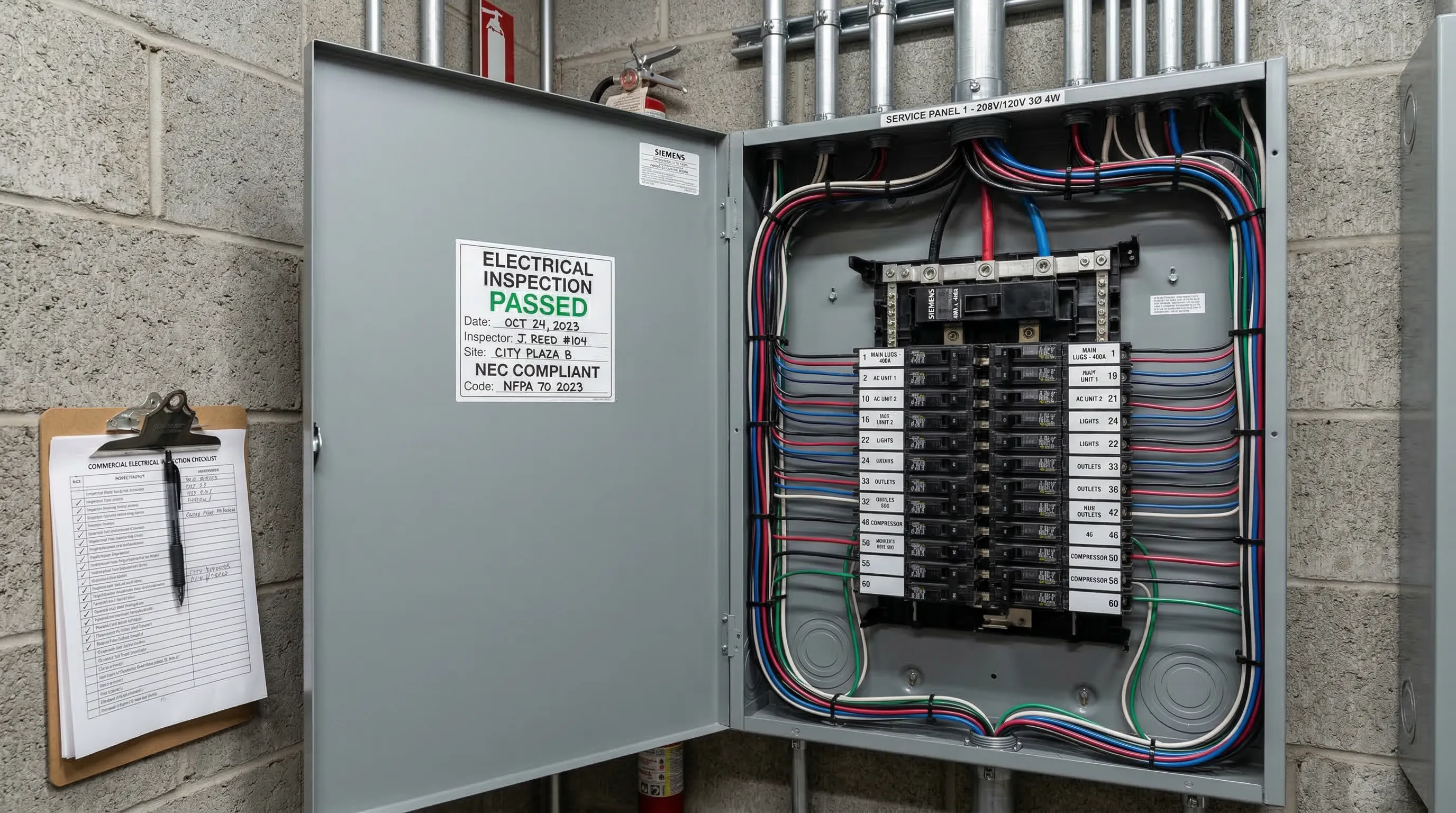
An electrical code violation in a commercial building doesn't just mean a failed inspection. It means a delayed opening, a voided insurance claim, a fire marshal citation, or — in the worst case — a fire that could have been prevented. Atlanta's commercial building stock spans over a century, from converted cotton warehouses in Castleberry Hill to new-build office towers in Midtown. Each building carries its own code compliance challenges, and the consequences of ignoring them compound over time.
This guide covers the electrical code framework that applies to Atlanta commercial properties, the most common violations we encounter, how to prepare for inspections, and when existing buildings get pulled into current code requirements. If you own or manage a commercial property in metro Atlanta, this is the compliance baseline you need to understand.
The Code Framework: NEC, Georgia Amendments, and Local Jurisdictions
Electrical code compliance in Atlanta operates on three layers:
- National Electrical Code (NEC): Published by the National Fire Protection Association (NFPA), the NEC is the baseline. Georgia adopts the NEC by reference through the state building code. As of 2026, Georgia follows the 2023 NEC edition.
- Georgia amendments: The state modifies certain NEC provisions through the Georgia Safety Fire Commissioner's office. These amendments may relax or tighten specific national requirements.
- Local jurisdiction amendments: The City of Atlanta, Fulton County, DeKalb County, Cobb County, and Gwinnett County each may add further amendments. The City of Atlanta's Office of Buildings maintains its own set of local amendments that apply within city limits.
This layered system means the code that applies to your building depends on its physical address. A commercial property on Peachtree Street NE (City of Atlanta) follows slightly different rules than an identical building on Peachtree Industrial Boulevard in unincorporated DeKalb County. Your electrician must know which jurisdiction governs the property and which amendments apply.
Pro Tip
Before any commercial electrical project, confirm which jurisdiction governs your property. The City of Atlanta, Fulton County, DeKalb County, and Cobb County each have their own amendments to the NEC. Your electrician should pull the permit from the correct authority — the wrong jurisdiction means a voided permit and a re-inspection.
Top 10 Code Violations in Atlanta Commercial Buildings
After hundreds of commercial projects in metro Atlanta, certain violations appear repeatedly. These are the issues that delay inspections, trigger fire marshal concerns, and create liability exposure:
- Insufficient panel clearance. NEC 110.26 requires 36 inches of clear working space in front of every electrical panel rated up to 600V. We find boxes stacked in front of panels, shelving units blocking access, and water heaters installed within the required clearance zone. Every inspector checks this.
- Missing or non-functional emergency lighting. NFPA 101 (Life Safety Code) requires illuminated exit signs and emergency lighting on battery backup in all commercial buildings. Dead batteries, broken fixtures, and missing signs are the most common fire marshal citation in Atlanta retail spaces.
- No GFCI protection in required locations. Commercial kitchens, restrooms, and rooftops all require GFCI-protected receptacles. Older buildings often have standard outlets in these locations from before the code required GFCI protection.
- Open junction boxes. Every wire splice must be enclosed in a covered junction box. Open splices in ceiling spaces, above drop ceilings, and in mechanical rooms are a fire hazard and an automatic inspection failure.
- Overloaded circuits. Tenant spaces that were wired for one use and converted to another often carry more load than the circuits were designed for. A former small office converted to a hair salon with 6 blow dryers will overload a circuit sized for computers and desk lamps.
- Missing circuit directory. NEC 408.4 requires every panel to have a legible, accurate circuit directory identifying each breaker. Panels with blank labels, incorrect labels, or no directory at all are a common finding.
- Improper use of extension cords as permanent wiring. Extension cords running across ceilings, through walls, or used as permanent power feeds violate NEC 400.12. This is especially common in retail and restaurant environments where the owner added equipment after the buildout.
- Exposed wiring and damaged conduit. Physical damage to wiring — crushed conduit, exposed conductors, missing cable clamps — creates shock and fire hazards.
- Unlabeled disconnects. Every disconnect switch must identify the equipment it controls. Unlabeled disconnects in mechanical rooms and on rooftops make it impossible for emergency responders to safely isolate power.
- Outdated fire alarm circuits. Older fire alarm panels may not meet current monitoring requirements, or individual devices (smoke detectors, pull stations, horn/strobes) may be past their listed service life.
When Existing Buildings Must Meet Current Code
One of the most misunderstood aspects of electrical code compliance is the "grandfather" concept. Existing buildings are generally permitted to remain under the code that was in effect when the electrical system was installed — but this protection has limits.
Current code is triggered when:
- New electrical work is performed. Any new circuit, outlet, fixture, or panel modification must meet the current NEC. The existing wiring can stay as-is, but the new work must be current-code compliant.
- The occupancy type changes. Converting a warehouse to a restaurant, an office to a daycare, or a retail store to a medical clinic triggers a code review because different occupancy types have different electrical requirements. The electrical system must be brought into compliance with the requirements of the new occupancy.
- The building undergoes substantial renovation. If more than 50% of the building's systems are being renovated (the exact threshold varies by jurisdiction), the entire electrical system may need to be brought up to current code.
- A specific hazard is identified. If a fire inspector, building inspector, or insurance inspector identifies a condition that poses an immediate hazard — regardless of when it was installed — the property owner is required to correct it.
Free Download: Seasonal Electrical Maintenance Checklist
Keep your home's electrical system safe year-round with our printable seasonal checklist — built by a master electrician.
Get the Free ChecklistPreparing for a Commercial Electrical Inspection
Whether you're opening a new business, completing a tenant buildout, or responding to a fire marshal inspection, preparation makes the difference between a first-pass approval and a costly re-inspection cycle.
Before the Inspector Arrives
- Verify all panel directories are legible and accurate
- Clear 36 inches of working space in front of every panel and disconnect
- Test all emergency lighting and exit signs — replace dead batteries
- Confirm GFCI protection is functional in all required locations (press the test button on each device)
- Cover all junction boxes — no open splices anywhere in the building
- Remove extension cords used as permanent wiring
- Verify all disconnects are labeled
Documentation to Have Ready
- Permit card (posted at the job site during construction)
- Electrical plan set (stamped and approved by the building department)
- Load calculations showing the building's electrical demand vs. available capacity
- Emergency lighting test logs (monthly 30-second tests, annual 90-minute tests)
- Fire alarm inspection reports (if the fire alarm system was part of the scope)
At JD Works Electrical, we handle inspection coordination as part of every commercial project. We pull the permit, schedule the inspection, meet the inspector on-site, and address any corrections immediately. Our goal is a first-pass inspection every time — because re-inspections delay your timeline and cost you money. See our full commercial electrical services.
The Cost of Non-Compliance
Skipping permits and ignoring code violations is a gamble that rarely pays off. Here's what's at stake:
- Insurance denial: Commercial property insurance policies typically exclude coverage for losses caused by electrical work that wasn't performed to code or wasn't permitted. A fire traced to non-code-compliant wiring can void your entire claim.
- Lease complications: Most commercial leases require the tenant to maintain the space in compliance with all applicable codes. A landlord can hold the tenant responsible for code violations discovered during inspections.
- Sale and refinancing hurdles: Commercial property transactions include due diligence inspections. Code violations discovered during a sale or refinancing can delay closing, reduce the property value, or kill the deal.
- Personal liability: In Georgia, building owners and managers can be held personally liable for injuries or deaths caused by known code violations that weren't corrected.
Safety Warning
Code compliance isn't red tape — it's the electrical system's immune system. It catches the problems that are invisible until the day they catch fire or put someone in the hospital.
Getting Your Building Up to Standard
If your commercial property hasn't had an electrical assessment in several years, the first step is a comprehensive walk-through with a licensed electrician. We inspect every panel, junction box, receptacle, and fixture; document violations; and provide a prioritized correction plan. Critical safety issues (open splices, missing emergency lighting, overloaded circuits) get addressed first. Cosmetic or administrative items (label updates, directory corrections) follow.
For tenant improvement projects, we integrate code compliance into the buildout scope from the start — catching violations during construction rather than during the final inspection, when corrections are expensive and time-consuming.
Frequently Asked Questions
The City of Atlanta and surrounding metro counties adopt the National Electrical Code (NEC) with Georgia-specific amendments. As of 2026, Georgia follows the 2023 NEC. Local jurisdictions may add amendments — the City of Atlanta Office of Buildings publishes its specific amendments on the city website.
The inspector issues a correction notice listing every violation. You have a specified window — typically 30 days — to correct the issues and schedule a re-inspection. The building cannot receive a Certificate of Occupancy or pass a fire inspection until all electrical corrections are made. Repeated failures can result in fines and stop-work orders.
Not automatically. Existing buildings are generally grandfathered under the code in effect when they were built, unless new work is performed, the occupancy type changes, or a specific hazard is identified. However, any new electrical work — even in an old building — must meet the current NEC. A change of occupancy (warehouse to restaurant, for example) triggers a full code review of the affected systems.
Is Your Commercial Property Up to Code?
JD Works Electrical performs code compliance assessments for commercial buildings across metro Atlanta. Find out where you stand before an inspector does.
Schedule a Code Compliance Assessment