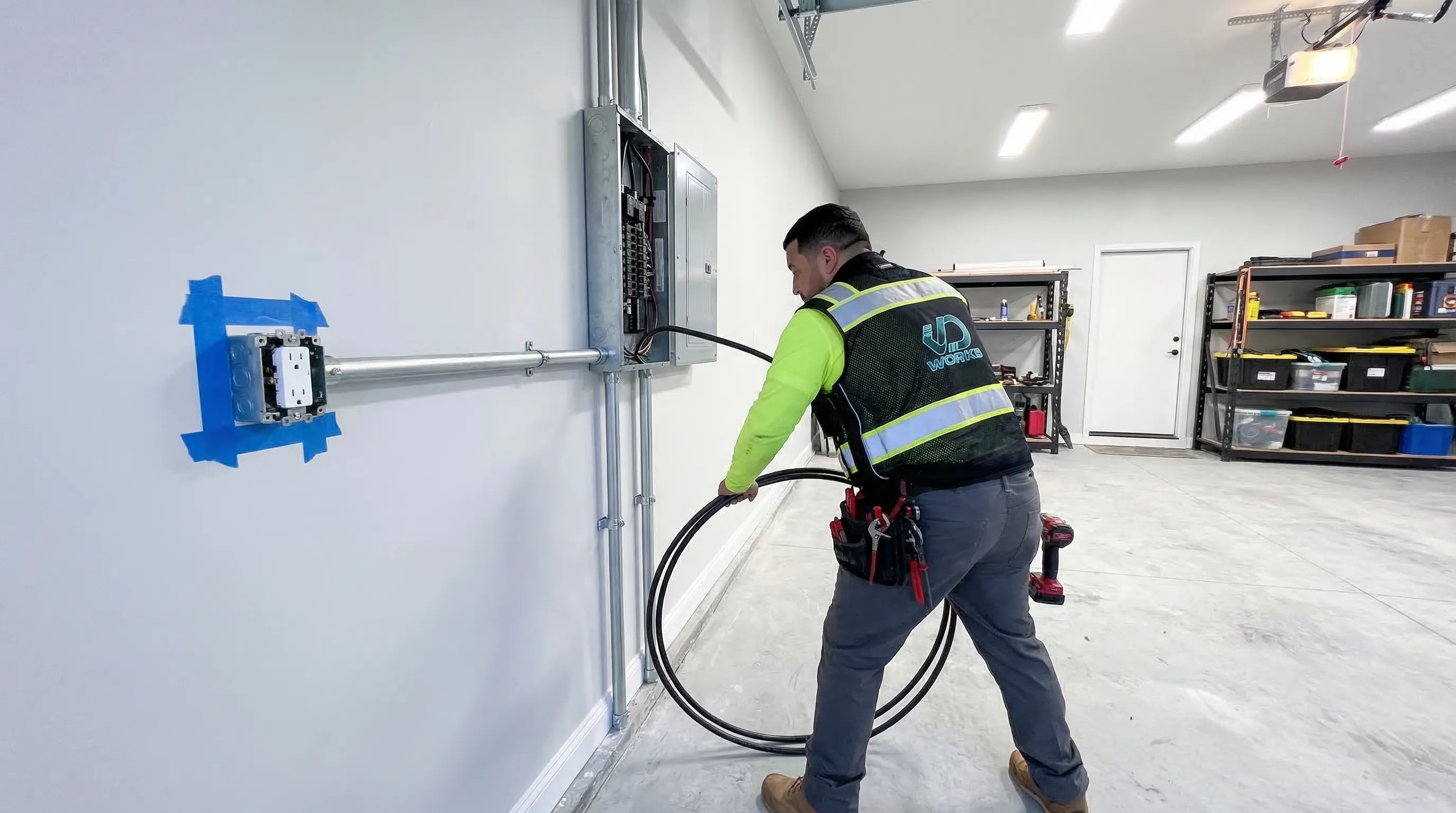
Georgia registered over 85,000 electric vehicles and plug-in hybrids by the end of 2025. Metro Atlanta accounts for more than 70% of those registrations, and the number is growing by 30-40% each year. If an EV is in your near future — or already in your driveway — your home's electrical system needs to support it. And if you are selling a home in the next five years, EV-ready infrastructure is becoming a legitimate selling point in Atlanta's real estate market.
Making a home EV ready means installing the electrical infrastructure for a Level 2 charger — the kind that adds 25-30 miles of range per hour and can fully charge most EVs overnight. This article covers exactly what that requires, what it costs, and how to plan it smartly so you are not paying twice for work that could have been done once.
Level 1 vs. Level 2 Charging: Why Level 2 Is the Practical Standard
Every EV comes with a Level 1 charging cord that plugs into a standard 120-volt household outlet. Level 1 charging adds 3-5 miles of range per hour. For a Tesla Model 3 with a 60 kWh battery that is completely flat, a full charge takes roughly 50 hours on Level 1. That is over two full days plugged in.
Level 2 charging uses a 240-volt circuit — the same type of circuit that powers your electric dryer or range. A 240V, 48-amp Level 2 charger adds 25-30 miles of range per hour. That same empty Tesla charges fully in about 8-10 hours. Plug in when you get home from work, and you wake up with a full battery every morning.
For anyone driving more than 30-40 miles per day (the average Atlanta commuter drives 32 miles daily), Level 2 is the only practical option for overnight home charging. Level 1 simply cannot keep up with daily driving.
Electrical Requirements for Level 2 EV Charging
Panel Capacity
A Level 2 EV charger draws 30-50 amps on a 240-volt circuit. That is a significant load — comparable to an electric dryer. Your electrical panel needs enough capacity to support this new circuit without overloading.
- 200-amp panel: Usually has room for a 50-amp EV circuit. Most homes with 200-amp service can add an EV charger circuit without modifications to the panel itself — assuming there are open breaker spaces available.
- 100-amp panel: Likely cannot support a 50-amp EV circuit alongside existing loads (HVAC, dryer, range, water heater). A load calculation is required to confirm, but in most cases, a panel upgrade to 200 amps is necessary before EV charger installation.
- 150-amp panel: May work depending on existing loads. A licensed electrician performs a load calculation per NEC Article 220 to determine if there is sufficient capacity.
Circuit Sizing
NEC requires that the circuit supplying an EV charger be rated for 125% of the charger's maximum continuous load. A 40-amp charger requires a 50-amp circuit. A 48-amp charger requires a 60-amp circuit. The most common residential setup is a 50-amp circuit with 6-gauge copper wire — this supports chargers up to 40 amps of continuous draw.
For future-proofing, I recommend running a 60-amp circuit with 6-gauge wire even if your current charger only draws 32 or 40 amps. The marginal cost increase for heavier wire is $50-$100 on a typical garage run, and it means you will not need to re-pull wire if you upgrade to a more powerful charger later.
Important
If your home has a 100-amp electrical panel, do not attempt to add a 50-amp EV circuit without a load calculation from a licensed electrician. The EV charger alone could consume 25-50% of your panel's total capacity, leaving insufficient power for HVAC, water heater, and other critical loads.
Outlet vs. Hardwired
EV chargers install in one of two ways:
- NEMA 14-50 outlet: A 240-volt, 50-amp outlet mounted on the garage wall. The charger plugs in. This is the most flexible option because you can unplug the charger and take it with you (useful if you move), and you can swap charger brands without rewiring. Most portable Level 2 chargers use this outlet type.
- Hardwired: The charger is permanently connected to the circuit through a junction box. Some wall-mounted chargers (like Tesla Wall Connector at 48 amps) are designed for hardwired installation. Hardwired units can draw higher amperage than plug-in units on the same circuit because NEC allows a hardwired connection to use 100% of the circuit rating for continuous loads (vs. 80% for plug-in).
Wire Run Distance
The distance from your electrical panel to the charging location directly affects cost. A panel in the garage with the charger on the same wall might only require a 10-foot wire run. A panel in the basement on the opposite side of the house from a detached garage could require a 100+ foot run. Longer runs also require larger wire gauge to prevent voltage drop — a 100-foot run on a 50-amp circuit needs 4-gauge wire instead of the 6-gauge used for shorter runs.
The "EV Ready" Approach: Install the Circuit Now, Add the Charger Later
Even if you do not own an EV yet, installing the circuit and outlet now is significantly cheaper than doing it later. Here is why:
- Bundled with other work: If you are already doing a panel upgrade, kitchen renovation, or any electrical project, adding an EV circuit is marginal additional cost — $400-$600 on top of the existing project. As a standalone project, the same circuit costs $800-$1,200 because the electrician has to make a dedicated trip, set up, and potentially open finished spaces.
- Home resale value: EV-ready homes sell faster and command a small premium in metro Atlanta. Real estate agents are increasingly listing EV charger infrastructure as a feature. The 2025 National Association of Realtors survey found that 42% of home buyers consider EV charging capability a desirable feature.
- Avoid disruption later: Running a circuit through finished walls and ceilings means cutting drywall, pulling wire, and patching afterward. If the walls are already open during a renovation, the wire pull adds almost no disruption.
Free Download: Seasonal Electrical Maintenance Checklist
Keep your home's electrical system safe year-round with our printable seasonal checklist — built by a master electrician.
Get the Free ChecklistInstallation Process for EV Ready Electrical
Here is what the electrical work looks like, step by step:
- Load calculation: The electrician calculates your home's total electrical load to confirm the panel can support a new 50-60 amp circuit. If the panel is at or near capacity, a panel upgrade is recommended first.
- Panel work: Install a new 50-amp or 60-amp double-pole breaker in the panel. If you are also adding solar panel infrastructure, both breakers can be installed during the same panel session.
- Wire run: Pull 6-gauge (or 4-gauge for long runs) copper NM-B or THWN wire from the panel to the garage or charging location. Route through the attic, crawl space, or along exterior walls depending on the most practical path.
- Outlet or junction box: Install a NEMA 14-50 outlet or a junction box at the charging location, mounted at the appropriate height (typically 42-48 inches from the floor for a wall-mounted charger).
- Inspection: Depending on your jurisdiction, a permit and inspection may be required. Most metro Atlanta counties require permits for new 240-volt circuits.
Costs for EV Ready Electrical in Atlanta
- 50-amp circuit (short run, under 30 feet): $400-$800
- 50-amp circuit (long run, 30-75 feet): $800-$1,500
- 50-amp circuit (detached garage, 75+ feet): $1,500-$2,500
- 200-amp panel upgrade (if needed): $1,800-$3,500
- Level 2 charger (plug-in, 32-40 amp): $300-$500
- Level 2 charger (hardwired, 48 amp): $500-$700
- Federal tax credit: 30% of charger + installation cost, up to $1,000
For complete details on charger types, brands, and the Atlanta permitting process, read our full EV charger installation guide.
Combining EV Charging with Solar
If you are considering both an EV and solar panels, planning both electrical projects together makes financial and practical sense. A 7 kW solar system in Atlanta produces roughly 28-30 kWh per day — enough to cover the daily charging needs of an average EV commuter (10-12 kWh per day for a 30-mile commute) with plenty left over to offset your household electricity consumption.
The electrical synergy is straightforward: both projects require panel capacity, both benefit from a 200-amp service, and both involve conduit runs and breaker installations that are cheaper to do simultaneously. Read our solar electrical requirements guide for the full picture.
Pro Tip
The homeowners who save the most money on EV charging are the ones who plan ahead. I had a client in Dunwoody who paid $600 for an EV circuit during their kitchen renovation. Their neighbor across the street — same house plan, same panel location — paid $1,400 six months later because the walls were finished and we had to route through the attic. Same circuit, same outlet, same result. Timing made the difference.
Frequently Asked Questions
An EV-ready home has the electrical infrastructure in place to support a Level 2 (240-volt) electric vehicle charger. This means a 200-amp electrical panel with available circuit capacity, a dedicated 50-amp 240-volt circuit run to the garage or parking area, and either a NEMA 14-50 outlet or a hardwired connection point for an EV charger. Making your home EV ready before buying saves time and money.
The cost depends on your current electrical panel and the distance from the panel to the charging location. If your panel has capacity, running a new 50-amp circuit costs $400-$1,200 depending on wire run length. If you also need a panel upgrade from 100 to 200 amps, add $1,800-$3,500. A federal tax credit covers 30% of charger and installation costs up to $1,000.
Technically yes, but it is extremely slow. A standard 120-volt outlet adds only 3-5 miles of range per hour — a full charge takes 40-50 hours. Level 2 charging on a 240-volt circuit adds 25-30 miles per hour, completing a full charge overnight. For daily driving, Level 2 is the practical minimum. Read more in our energy efficiency guide.
Make Your Home EV Ready
Whether you are buying an EV next month or next year, getting the electrical done now saves money. Get a free quote for EV-ready wiring from a master electrician.
Get an EV Ready Quote