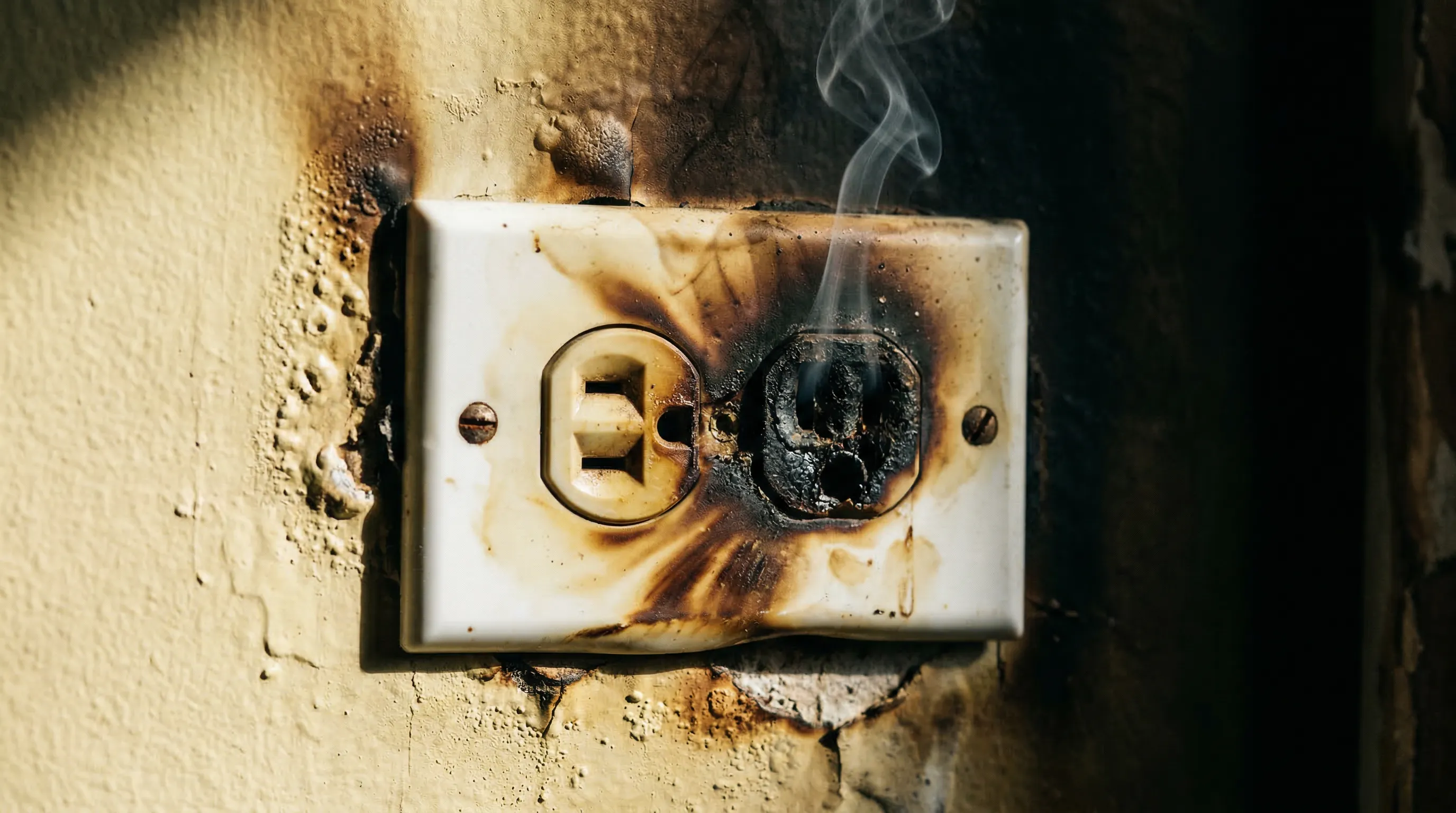
You walk past a bedroom wall and catch a sharp, plasticky smell coming from the outlet behind the nightstand. Maybe it is faint. Maybe it is strong enough to make you stop mid-step. Either way, a burning smell from an outlet is never something to shrug off. That smell means something inside your wall is overheating, and the window between "strange odor" and "house fire" can be disturbingly short.
I have been a licensed electrician in metro Atlanta for over a decade. I have pulled outlets out of walls where the plastic housing had melted into the drywall, where copper wiring had turned black, and where the only reason the house was still standing was because someone paid attention to a weird smell and called for help. This article explains exactly what causes that burning smell, how to respond in the moment, and when to call a professional.
What Causes a Burning Smell from an Electrical Outlet?
The smell itself comes from materials overheating. Outlet housings are made of thermoplastic. Wire insulation is usually PVC or thermoplastic. When electrical current generates too much heat at a connection point, those materials start to break down. Here are the most common causes.
Loose Wire Connections
This is the number one cause I see on service calls in Atlanta. Over time, the screw terminals on an outlet loosen. When a wire connection is not tight, electricity has to arc across a tiny gap to complete the circuit. That arc generates heat. The heat melts insulation. The melted insulation creates the burning smell. Homes built in the 1970s and 1980s are especially prone to this because backstab connections (where wires push into spring-loaded holes instead of wrapping around screws) loosen faster than screw terminals.
Overloaded Circuits
A standard 15-amp residential circuit is designed to handle about 1,440 watts of continuous load. Plug a space heater (1,500 watts) into the same circuit as a hair dryer (1,800 watts) and you are pulling over twice what the circuit was built for. The wiring heats up, the outlet heats up, and you get that burning smell. This is especially common in older Atlanta homes that were wired with fewer circuits than modern appliances demand. If your electrical panel still has a 100-amp service, overloaded circuits are almost guaranteed.
Damaged or Deteriorated Wiring
Wire insulation does not last forever. In homes 40 years and older, the insulation can dry out, crack, and flake away. Exposed copper conductors can touch each other or contact metal junction boxes, creating short circuits and heat. Rodents also chew through wiring — Atlanta's mild winters mean rats and squirrels stay active year-round, and they love the warmth inside wall cavities. If your home shows signs it needs rewiring, a burning outlet smell may be the most urgent one.
Faulty Outlet or Switch
Outlets wear out. The internal contacts that grip the plug prongs weaken over years of use. When the grip loosens, the plug does not make solid contact, and the resulting resistance generates heat. Cheap builder-grade outlets (the $0.50 ones) fail faster than commercial-grade or hospital-grade receptacles. If the outlet feels warm to the touch even with nothing plugged in, the outlet itself is probably the problem.
Arcing Behind the Wall
This one is harder to detect because the problem is not at the outlet — it is somewhere along the wire run between the outlet and the panel. A nail or screw driven through drywall during a renovation might have nicked a wire. A staple holding Romex cable might have been driven too hard and damaged the insulation. The arc happens behind the wall where you cannot see it, but you can smell it. Arc-fault circuit interrupters (AFCIs) are specifically designed to detect this type of fault and shut the circuit down before a fire starts.
What a Burning Electrical Smell Actually Smells Like
Homeowners describe it in different ways. The most common descriptions I hear on calls are:
- Melting plastic — sharp, chemical, and acrid. This is overheating thermoplastic from the outlet housing or wire insulation.
- Hot rubber — similar to a rubber band stretched over a heat source. Usually indicates the wire insulation itself is breaking down.
- Fishy odor — this one surprises people. Certain plastics and resins used in electrical components emit a fishy smell when they overheat. If you smell fish and there is no fish in your house, check your outlets and your electrical panel.
- Metallic or ozone smell — this is the smell of electrical arcing itself. It is sharp and clean, almost like the air after a lightning strike.
Any of these smells near an outlet, switch plate, or circuit breaker panel warrants immediate action.
Pro Tip
If you smell something fishy in a room and there is no fish in the house, check your outlets and electrical panel. Certain plastics and resins in electrical components emit a fishy odor when they overheat. It is one of the most commonly missed warning signs of an electrical problem.
Immediate Steps When You Smell Burning from an Outlet
Here is what to do, step by step, the moment you detect a burning smell from an outlet.
- Stop using the outlet. Unplug everything connected to it. Do not plug anything back in.
- Check for visible damage. Look at the outlet faceplate. Is it discolored? Melted? Warm or hot to the touch? Are there scorch marks on the wall around it? Do not remove the faceplate yourself unless you are comfortable working around electrical components.
- Turn off the circuit breaker. Go to your electrical panel and flip off the breaker controlling that outlet. If you do not know which breaker it is, flip off the main breaker. Your family's safety is more important than keeping the lights on.
- Check for smoke or flames. If you see smoke coming from the outlet or the wall, leave the house immediately and call 911. Do not try to put out an electrical fire with water.
- Call a licensed electrician. Even if there is no visible fire, you need a professional to open the outlet, inspect the wiring, and determine the root cause. This is not a DIY repair. The problem may be at the outlet, or it may be somewhere inside the wall where you cannot reach it.
Safety Warning
In 15 years of electrical work, the calls that scare me most are the ones where the homeowner says they have been smelling something "off" for weeks but kept putting it off. An outlet fire can go from smoldering behind drywall to a full house fire in under four minutes.
Free Download: Seasonal Electrical Maintenance Checklist
Keep your home's electrical system safe year-round with our printable seasonal checklist — built by a master electrician.
Get the Free ChecklistWhen a Burning Outlet Smell Is an Emergency
Every burning outlet smell should be taken seriously, but some situations cross into emergency electrical repair territory. Call immediately or go to your panel and kill the main breaker if you notice any of the following:
- Visible smoke from the outlet, wall, or ceiling
- Sparks or flashes of light from the outlet
- The outlet or surrounding wall is hot (not just warm — hot)
- Buzzing, crackling, or sizzling sounds from the outlet or inside the wall
- Scorch marks, melted plastic, or discoloration on the outlet or faceplate
- The burning smell is getting stronger over time
- Multiple outlets on the same circuit show similar symptoms
If a storm recently passed through and you are now noticing electrical smells, storm damage to your electrical system may be the cause. Lightning strikes and power surges can damage wiring in ways that are not immediately visible.
How an Electrician Diagnoses and Fixes the Problem
When I arrive on a burning-smell call, here is what the diagnostic process looks like:
Visual Inspection
I remove the outlet faceplate and pull the receptacle out of the box. I am looking for melted plastic, blackened wires, loose connections, and signs of arcing (pitting on the wire or terminal). I also check the wire gauge — if someone ran 14-gauge wire on a 20-amp circuit, that is a code violation and a fire risk.
Thermal Imaging
For problems behind the wall, a thermal camera reveals hot spots that the eye cannot see. I scan the wall around the outlet and along the wire path back toward the panel. Hot spots indicate arcing, a loose splice in a junction box, or deteriorated insulation.
Circuit Testing
I test the circuit for voltage, amperage, and continuity. I check whether the circuit is overloaded by measuring the total load against the breaker rating. I also test for ground faults and arc faults.
The Repair
The fix depends on the root cause. It could be as straightforward as replacing a damaged outlet ($15 in parts, about 30 minutes of labor) or as involved as running new wire through the wall. If the panel itself shows signs of overheating, a full panel upgrade might be the right move. If wiring throughout the home is degraded, we may recommend whole-house rewiring.
Preventing Burning Outlet Smells in the First Place
Most outlet fires are preventable. Here is what I tell every homeowner in Atlanta:
- Do not overload circuits. Spread high-draw appliances across multiple circuits. Space heaters, window AC units, and hair dryers should each have their own circuit if possible.
- Replace old outlets. If your outlets are original to a home built before 1990, they are past their expected service life. A licensed electrician can swap them out in an afternoon.
- Use surge protectors. A good surge protector prevents voltage spikes from damaging outlets and appliances. A whole-home surge protector installed at the panel offers even better protection.
- Schedule electrical inspections. The National Fire Protection Association recommends an electrical inspection every 10 years for owner-occupied homes, or whenever you buy a home. In Atlanta's older neighborhoods — Virginia-Highland, Grant Park, Inman Park, Decatur — I recommend every 5 years.
- Pay attention to warning signs. Flickering lights, outlets that spark when you plug something in, warm faceplates, and tripped breakers are all early warnings. Do not wait for the burning smell.
Atlanta-Specific Concerns
Atlanta's housing stock creates specific risks. Homes in Buckhead, Midtown, and the surrounding neighborhoods range from 1920s bungalows with original knob-and-tube wiring to 1960s ranch homes with aluminum wiring to 1990s McMansions with overloaded builder-grade panels. Each era has its own failure patterns.
The heat and humidity also play a role. Georgia summers push air conditioning systems hard, which loads up circuits. Humidity accelerates corrosion on wire connections, especially in crawl spaces and unfinished basements. And Atlanta's frequent summer thunderstorms deliver power surges that weaken wiring over time — sometimes the damage from a power outage or surge does not show up for months.
Frequently Asked Questions
Yes. A burning smell from an outlet indicates overheating wiring, a loose connection, or melting insulation — all of which can start an electrical fire. Stop using the outlet immediately, unplug all devices, and call a licensed electrician. If you see smoke, leave the house and call 911. Read more about emergency electrical situations.
Burning electrical wiring produces a sharp, acrid odor similar to melting plastic or hot rubber. Some homeowners describe it as a fishy smell. If you notice this near any outlet or switch, treat it as an urgent safety issue and turn off the circuit breaker for that area.
Yes. Unplug everything from the outlet first, then switch off the circuit breaker controlling that outlet. Do not use the outlet again until a licensed electrician inspects and repairs the issue. If you see smoke or flames, leave the house and call 911. Consider whether your home may need a panel upgrade if this is a recurring issue.
Smell Something Burning? Do Not Wait.
A burning outlet smell is your home warning you. Let a licensed master electrician inspect your wiring and make it safe.
Schedule an Inspection