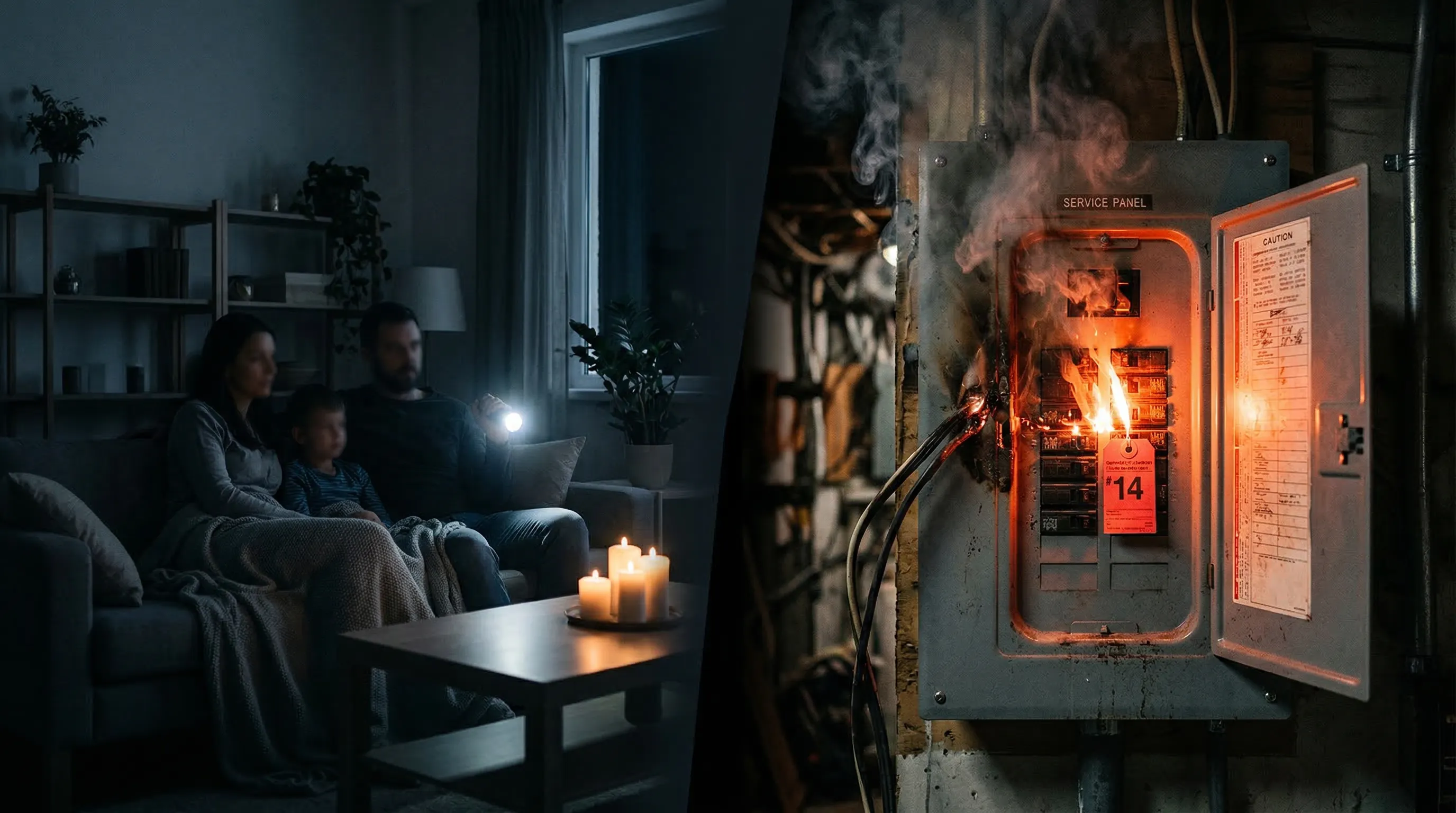
The lights go out. Your first instinct is to check your phone — is the Wi-Fi down too? You walk to the window and see the neighbor's porch light still on. Now what? Is this a simple power outage that Georgia Power will fix in an hour, or is something wrong inside your house that needs an electrician right now?
The distinction between a power outage and an electrical emergency matters because it determines who you call, how urgently you act, and whether your family is safe. A utility outage is an inconvenience. An electrical emergency is a safety threat. This guide walks you through how to tell the difference in real time, what to do in each scenario, and the warning signs that mean you should not wait.
Power Outage: Utility-Side Problem
A power outage happens when the electrical supply from the utility is interrupted before it reaches your home's electrical system. Nothing inside your house caused it, and nothing inside your house can fix it. You wait for the utility to restore service.
Signs It's a Utility Outage
- The whole neighborhood is dark. Street lights are off, neighbors' homes are dark, and traffic signals on nearby intersections may be out.
- It happened suddenly with no warning. One moment everything was normal, the next moment everything went dark — no flickering, no popping sounds, no smell.
- A storm just passed through. Atlanta thunderstorms knock out power regularly. Lightning strikes on utility lines, fallen trees on distribution wires, and wind damage to utility poles are the most common causes.
- Georgia Power's outage map confirms it. Check the map at georgiapower.com/outage-map or through their mobile app. If your area shows an active outage with an estimated restoration time, it's on their side.
What to Do During a Utility Outage
- Report it. Call Georgia Power at 1-888-891-0938 or use their app. Even if it's already reported, your report helps them understand the scope and prioritize crews.
- Unplug sensitive electronics. Power restoration often comes with a voltage surge. Unplug computers, TVs, gaming consoles, and other sensitive equipment. Leave a single lamp plugged in so you know when power returns.
- Keep refrigerators and freezers closed. A closed refrigerator holds safe temperature for about 4 hours. A full freezer maintains temperature for 48 hours (24 hours if half full). Every time you open the door, you lose cold air.
- Use flashlights, not candles. Candles cause house fires during power outages. Use battery-powered flashlights and lanterns.
- If the power's out, leave it to the pros. Don't attempt DIY rewiring around a damaged service panel. Wait for utility and licensed electrician to clear the area before reconnecting anything.
Safety Warning
If you smell burning insulation, see smoke from any outlet, or hear arcing inside the panel, shut off the main breaker and call a licensed electrician. Don't open the panel yourself. The same applies to commercial kitchens — a tripped breaker on a hood circuit during service is a sign of a deeper problem, not just an inconvenience.
Electrical Emergency: House-Side Problem
An electrical emergency is a failure or hazard within your home's electrical system — from the meter base inward. It requires an electrician (and sometimes 911) regardless of whether the utility grid is functioning normally.
Signs It's an Electrical Emergency
- Only your house lost power. Neighbors have lights, street lights are on, but your home is completely dark. Your main breaker may have tripped, or your service entrance has a problem.
- Half the house is dark, half has power. This classic symptom of a single-phase loss means one of the two 120V legs feeding your home has failed. Causes include a loose connection at the meter, a damaged utility drop, or a failed connection inside the panel. Some appliances and lights work; others don't. 240V appliances (dryer, oven, AC) may not work at all or may run weakly.
- You heard a pop or bang before the power went out. An audible pop indicates a short circuit or arc fault. Something failed inside your electrical system — a breaker, a wire connection, or a device.
- You smell something burning. Burning plastic, burning rubber, or a metallic hot smell near any outlet, switch, or panel is an emergency. Something is overheating and will not cool down on its own.
- You see sparks, smoke, or discoloration. Visible sparking from an outlet, scorch marks around a switch plate, or smoke from behind a wall means active electrical arcing or thermal damage.
- An outlet or switch is hot to the touch. A warm cover plate is abnormal. A hot cover plate is dangerous. Turn off the circuit immediately.
- The breaker trips repeatedly. A breaker that won't stay on after one reset attempt is protecting you from a fault. The fault must be found and fixed. Do not keep resetting it. Learn more about why breakers trip.
The Gray Zone: Problems That Could Be Either
Some situations aren't immediately clear:
Flickering Lights
Lights that flicker briefly during a storm are usually caused by utility-side disturbances — tree branches touching lines, momentary faults on the grid. This is normal and not an emergency.
Lights that flicker persistently without a storm, especially when large appliances turn on, may indicate a loose connection inside your home's electrical system — at the panel, the meter base, or the service entrance. If the flickering is getting worse over time, call an electrician during business hours. If it's accompanied by a burning smell or buzzing sound, treat it as an emergency.
GFCI Outlet Keeps Tripping
A GFCI outlet that trips repeatedly is detecting a ground fault somewhere on the circuit. This isn't typically a fire emergency, but it does mean something is wrong — a faulty appliance, moisture in an outdoor outlet, or a wiring issue. Unplug everything connected to the GFCI circuit, reset it, and if it stays on, plug devices back in one at a time to identify the culprit. If it trips with nothing plugged in, the problem is in the wiring and needs an electrician.
Tripped Breaker After Storm
A single tripped breaker after a storm could be caused by a lightning-induced surge (utility-side event affecting your equipment) or by storm damage to your house wiring (house-side problem). Reset the breaker once. If it stays on, monitor for unusual smells or heat. If it trips again, leave it off and call an electrician.
Free Download: Seasonal Electrical Maintenance Checklist
Keep your home's electrical system safe year-round with our printable seasonal checklist — built by a master electrician.
Get the Free ChecklistWhen to Call 911 vs. an Electrician
The decision tree is straightforward:
- Call 911 if you see flames, smell smoke, see active arcing or sparking that won't stop, have a downed power line on or near your property, or if anyone has received an electrical shock.
- Call an electrician for burning electrical smells without visible flames, breakers that won't reset, complete power loss limited to your home, half-house power loss, hot outlets or switches, and storm damage to your service entrance (after confirming no downed lines).
- Call the utility for neighborhood-wide outages, downed power lines (also call 911 for safety), and flickering that correlates with visible utility line problems.
After the Emergency: What Happens Next
Once the immediate emergency is resolved — the fire department has cleared the scene, the utility has restored grid power, or the electrician has stabilized your system — there's still follow-up work to do.
After a lightning strike, have your entire electrical system inspected. Lightning can damage wiring inside walls in ways that aren't visible but create fire risks weeks later. After storm damage to the service entrance, the repair may require coordination between the electrician (who fixes the house side) and the utility (who reconnects the grid side). After a breaker panel failure, discuss whether the panel should be repaired or replaced — if the panel is over 25 years old or has a history of problems, replacement is the smarter long-term investment.
Read our full emergency electrical repair guide for detailed information on the repair process, costs, and preparation steps.
Safety Warning
The difference between a power outage and an electrical emergency comes down to one question: is the problem outside the meter or inside? Outside — call the utility and wait. Inside — call an electrician. If there's fire, smoke, or danger to people — call 911 first, always.
Frequently Asked Questions
Look outside — check if street lights are on and if neighboring houses have lights visible through windows. Check Georgia Power's outage map on their website or app, which shows reported outages by area in near real-time. If neighbors have power and you don't, the problem is on your side of the meter — check your main breaker panel.
Yes. Any burning smell from an outlet, switch, or electrical panel should be treated as an emergency. Turn off the circuit breaker serving that area immediately. If you cannot identify which breaker controls it, turn off the main breaker. If you see smoke or flames, evacuate the house and call 911. A burning smell means something is overheating — it will not fix itself, and ignoring it risks a fire.
Your home's electrical service enters as two 120-volt legs that combine for 240 volts. If one leg fails — from a loose utility connection, a damaged service entrance cable, or a problem at the transformer — you lose power to roughly half of your circuits while the other half continues working. This condition is called a single-phase loss and requires an electrician or utility response to fix.
Not Sure If It's an Emergency? Call Us.
JD Works Electrical can help you determine whether your situation needs immediate attention. If it does, we'll be there fast. If it can wait, we'll schedule you at a time that works.
Call (470) 240-6142